Performing Arts Facilities In Education Settings

McMillan Theatre sliding header

Performing Arts Facilities In Education Settings

By Kate Thomas, Director and Head of Interior Design at Austin-Smith:Lord

Performance Arts is a strong and vital industry within the UK economy. Amongst other notable recent developments, the growing UK TV industry and the resurgence in Arts activity since the easing of pandemic restrictions are feeding into this. Wales in particular is enjoying a surge in investment in the TV and film industry including major Hollywood film productions, with a growing recruitment programme in this sector. The leisure sector is ‘on the up’ coming out of the pandemic, as is being published by financial forecasters such as Deloitte. This is intrinsically linked with Performing Arts which occupies a substantial chunk of leisure economic activity between theatre, TV and film and cinema which run alongside and intersect with other leisure sectors such sport, travel and food and drink. Preparing the next generation for immersion in the Performing Arts industry, from the perspective of performers, production roles and of course audiences, is certainly key to the future success of this sector with all of the enriching cultural and economic benefits it brings.

How are we currently achieving this preparation in schools, colleges & universities across the UK and how will this increasingly affect required facilities improvement and building design going forward?

Schools:

Nationally across the UK the expectation of pupils and staff in terms of the quality and professionalism of performing arts leaching spaces and equipment is growing at pace, soon to catch up with facilities historically only expected in professional settings. In schools, a few extra lights and modular stage blocks in the school hall is being leapfrogged with more professional lighting rigs, flexible spaces allowing various performance configurations and staging, bespoke drama and recording studios , dance studios with sprung floors, acoustically tuned spaces, more accessible changing facilities, and the list goes on.

Fitzalan High School in Cardiff is currently in construction. Austin-Smith:Lord has put bringing the school together for Performing Arts and presentations to the front and centre of the design, with an innovative flexible heart space for different scales and types of event with consideration for cohort numbers, whole school events, sightlines, lighting and acoustics.  There is a bespoke audio visual system within this space which responds to various configurations of conjoining spaces, allowing immersive and shared experiences wherever you are located. Amongst other specialist facilities, the school will boast a flexible dance and activity studio with professional grade finishes, a dedicated drama studio, recording studios, music teaching, rehearsal and performance facilities. A dedicated steel pans room is located at the front of the building to showcase this particular specialism within the school. An exciting addition to the Performing Arts provision is an ‘immersion room’ using state of the art sound and projection equipment to create various 3D environments for students to experience virtual worlds in real time.

It is definitely important to understand what learning outcomes schools need to provide for pupils to fulfil the curriculum requirements for Performing Arts, as this is the backdrop which points to the challenge of the level of facilities that will be required in schools going forwards.

Fitzalan High School

In Welsh schools the new Curriculum coming in this September for ages 3-16 names Expressive Arts as one of the 6 key Areas of Learning & Experience. This spans five disciplines: art, dance, drama, film and digital media and music. In Scottish schools a similar Expressive Arts curriculum was launched with the current curriculum in 2019. The Welsh & Scottish drama curriculums are arguably more detailed and explicit in the requirements for Performing Arts than in England, and schools are designing their new lesson plans to make best use of the facilities at their disposal to achieve this as best they can. The new curriculums are aspirational in the learning outcomes within the subject, requiring familiarisation with digital platforms, as well as wide ranging roles within the industry. To illustrate this, in Wales, the requirements for drama alone (as separate from  art, dance, film and digital media and music)  include plot, character, thought, relationships (which encompasses interaction), tension, focus, place, time, language, voice (which encompasses accent, diction, pitch, tempo, pauses), movement (which encompasses gesture, facial expressions), proxemics, atmosphere, mood, symbols, design which encompasses stage lighting, sound, set, hair, make-up, costume, script writing, directing and stage management, comedy, tragedy, tragicomedy, farce, musical theatre, melodrama, mime, physical theatre”. 

Clearly some of these parameters require specific physical facilities and spaces. Going forward, facilities in Welsh & Scottish schools for this part of the curriculum should and will therefore be raised in priority beyond where they have historically been. Improving, refurbishing and extending facilities in existing schools and pushing the boundaries of design in new build schemes to give better learning opportunities will come together to achieve this.

In English schools, performance or drama as a subject doesn’t have its own section in the National Curriculum adopted in 2013. Instead it is a statutory part of English. As such the Spoken Language section reads as follows: All pupils should be enabled to participate in and gain knowledge, skills and understanding associated with the artistic practice of drama. Pupils should be able to adopt, create and sustain a range of roles, responding appropriately to others in role. They should have opportunities to improvise, devise and script drama for one another and a range of audiences, as well as to rehearse, refine, share and respond thoughtfully to drama and theatre performances.”  It is fair to say that there is flexibility in the interpretation of these comparatively inexplicit guidelines so schools vary widely in the facilities they offer to achieve them. This has led to a wide variety in the way in which schools fulfil their obligations within the curriculum, and inconsistency in the quality of facilities. Going forwards there will definitely need be a drive for more consistency across schools and augment the facilities in those with more a basic offering in line with the more advanced and newer schools through refurbishment and extension.

Further & Higher Education:

In Further and Higher education settings the specialist facilities for Performing Arts qualifications need to replicate those in professional industry environments to properly prepare and train the students technically. Recreating professional environments has the added benefit of attracting partnerships with external stakeholders within the professional industry who come and work and perform within the facilities which is a fantastic benefit to the staff and students. There has long been a drive to reinforce the connection between business, local communities and education establishments. This model has been pushed over recent years in management schools with business and entrepreneurship hubs being located on campus, linking industry investment and learning. But there is huge untapped potential to further this initiative within the Performing Arts sector. Raising the aspiration of facilities within education settings without doubt opens doors and exciting opportunities in the arts industry for students and attracts external investment – a model perfectly demonstrated by The McMillan Theatre at Bridgwater College designed by Austin-Smith:Lord. Performing Arts facilities within schools, colleges and universities are a great opportunity to do this and crucially can certainly bolster business plans for capital projects. I visited the McMillan Theatre recently to see how well it is ‘performing’ in a hindsight review. The building is bringing revenue to the College and attracting bigger and bigger shows. By day it is a teaching theatre for drama, production, live event management & theatre technicians. It also has a high specification dance studio with a sprung dance floor. By night it is the town’s theatre receiving touring shows, musicians, comedy and more.

McMillan Theatre, Bridgwater College

Much of the success has been down to the high specification of the auditorium both in terms of technical theatrical performance and the look and feel of the room which rivals the best provincial theatres.  It is also down to the flexibility built into the space, with a proscenium arch which can fold away making the stage part of the room, an orchestra pit which can be infilled and curved stalls seating which retracts into the wall behind for flat floor events, acoustics designed to a wide spectrum of events and accessibility for those with disabilities. It has stood the test of time for both college and community use. It is an impressive facility for students to have as their classroom and as such is attracting great numbers of course applicants, as well as a growing list of high profile touring shows. Performers love the intimate design of the 350 seats, with even the upper tiers of seating feeling close to the stage. It is used for balls, cabaret, standing rock concerts for 450 people. The variety of uses has bolstered the business plan and augmented the college curriculum, so bringing the two worlds together has been a huge success story.

Education in professional performing arts settings:

As Architects, Interior Designers and indeed Landscape Architects specialising in design for both education and the professional performing arts sectors Austin-Smith:Lord is fairly uniquely placed to cross pollinate experience and knowledge between the two sectors of Education and Performing Arts.

We eagerly await the completion of Shakespeare North, our latest theatre project. We have many exciting education schemes at various project stages from conception to completion, and what has triggered this thought piece is our  growing portfolio of designing education facilities within performing arts buildings and vice versa.

Birmingham Royal Ballet Refurbishment

We have worked with Birmingham Royal Ballet over recent years to refurbish then extend their training facilities, including new community changing facilities for school children to come for dance training sessions in the exciting and inspiring surroundings of a professional dance environment. The scheme allows for public benefactors to come and watch rehearsals behind the scenes and feel fully involved in the process. The benefits of engaging with the community and education in this way have been great and have raised the profile of the company locally and nationally.

The design challenge:

Pressure on budgets and available space means intelligent flexible design is key to providing the best possible facilities to inspire the next generation of Performing Arts professionals. Spaces that can transform in scale, acoustics and feel bring great value. This has to be balanced carefully against the need for rooms to be bespoke designed for individual purpose, such as specific acoustic and equipment requirements in designated spaces like recording studios. We predict that virtual reality technology and increased IT integration will become key to this in the future, allowing spaces to be digitally transformed as well as physically. Indeed, understanding the latest developments in the professional Arts industry as well as current drivers in educational pedagogy and educational curriculum requirements is the key to success in blending the two sectors to the benefit of all.

If you wish to discuss any of our past projects, or benefit from our experience in a future project, do get in touch.

Quickfire Questions with Rob Firman

Rob Firman banner

Quickfire Questions with Rob Firman

Name
Rob Firman.

When did you join Austin-Smith:Lord?
March 2008.

What is your role within our Creative Collective?
Director, and Arts & Culture / Heritage Sector Lead.

What are you working on at the moment?
A range of small projects in Listed Court buildings.

What inspires you most in your work?
Achieving unexpected outcomes that in turn inspire our clients.

What lessons have you learned in your work?
You need a lot of patience to specialise in arts, culture and heritage projects.

What is your favourite building?
The Basilica of the Sagrada Familia, Barcelona. Seeing it as a 10 year old boy showed me my path to architecture. I have visited it every 5-10 years over the last 50 and I hope very much to live long enough to see it finished.

What is your favourite Austin-Smith:Lord project and why?
Shrewsbury Museum, because it was my first listed building project and showed me a new path within Architecture.

What are the key issues facing our design professions in the 2020s? 
Design professionals have less and less exposure to the construction process so are losing the essential knowledge of how things get built;
Continuing to be able to deliver the excellent service we aspire to and our our clients expect with extremely competitive fees and rising costs;
We still don’t fully see the final impact of Grenfell…

What’s something you’re planning on doing in the next year that you’ve never done?
Take a road trip from San Francisco to the Bonneville Salt Flats via Yosemite and Monument Valley (for my 60th birthday in January 2023).

Complete the following -“I couldn’t get through the week without… my morning walk on the village common with my dog”.

A day in the life of Kate Thomas, Director at Austin-Smith:Lord

Kate Thomas A Day in the Life banner lo

A day in the life of Kate Thomas, Director at Austin-Smith:Lord

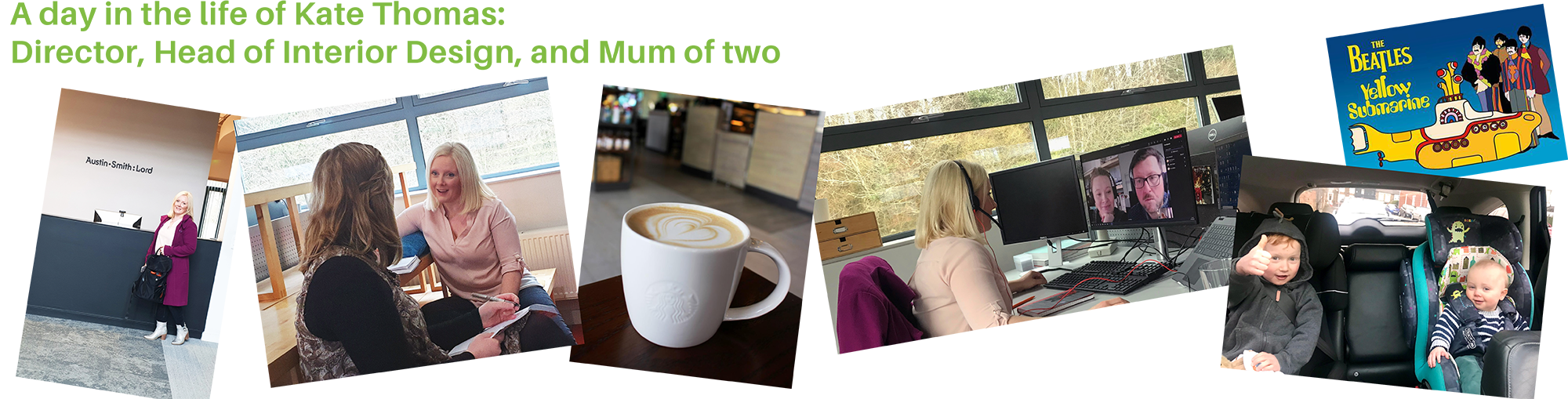
This International Women’s Day we are celebrating our female staff. Today we are following Kate to see what life as a Director, Head of Interior Design and a Mum of two is like on a typical Monday…

6am My morning usually starts around this time when one of my two young sons awake. My husband and I take it in turns to get ourselves ready while the other supervises breakfast, play and morning TV. ASL are supporting the staff preference to benefit from hybrid working, mixing time in the studio with working from home. On days in the studio I bundle the boys into the car at 8am to do the nursery and school run, then arrive at the studio just before nine. My 4yr old son is a massive fan of The Beatles so the school run is usually accompanied by Yellow Submarine at the moment!

9am – Once in the studio I say a hello to colleagues and check my emails with a cup of tea and breakfast at my desk. I’m doing Slimming World to shift the recent baby weight at the moment, so today it’s porridge and sliced apple quickly thrown together in the office kitchen. This is where the ‘standard day’ ends until 5:30pm! What I love about my job is how different every day is. I meet different people and work on varied types of design schemes each week.

9:30am Today is a Design Team Meeting on video conference for a university refurbishment project. We’re discussing the best distribution strategy for the ventilation. It’s tricky as there’s limited head-height and next to no ceiling voids, so we brainstorm solutions. We are also assessing energy efficiency improvement options for the building envelope, and their payback times, to ensure we are making the new scheme as energy efficient as possible.
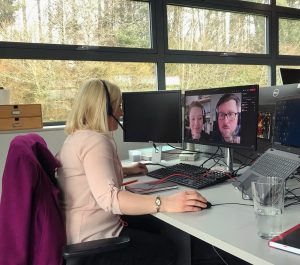
11:30am Cup of tea and divide up the actions from the meeting between colleagues in my team and brief them – on this project it’s Interior Designers James and Amy.  I’m privileged to work with a great team who work well together, so briefing is straightforward.

12pm Today is our monthly ‘all staff catch up’ on Teams with the fifty or so colleagues from our five studios across the UK. We take it in turns to do ‘magic minutes’ which are minute long presentations about our project. I love this section of the meeting, finding out more about what my colleagues are up to. Today, amongst others, there was a talk about a current project to convert an old convent into a luxury spa hotel near Stroud. I helped set the project up before heading off on maternity leave last year so it’s one I’m keeping a close interest in.

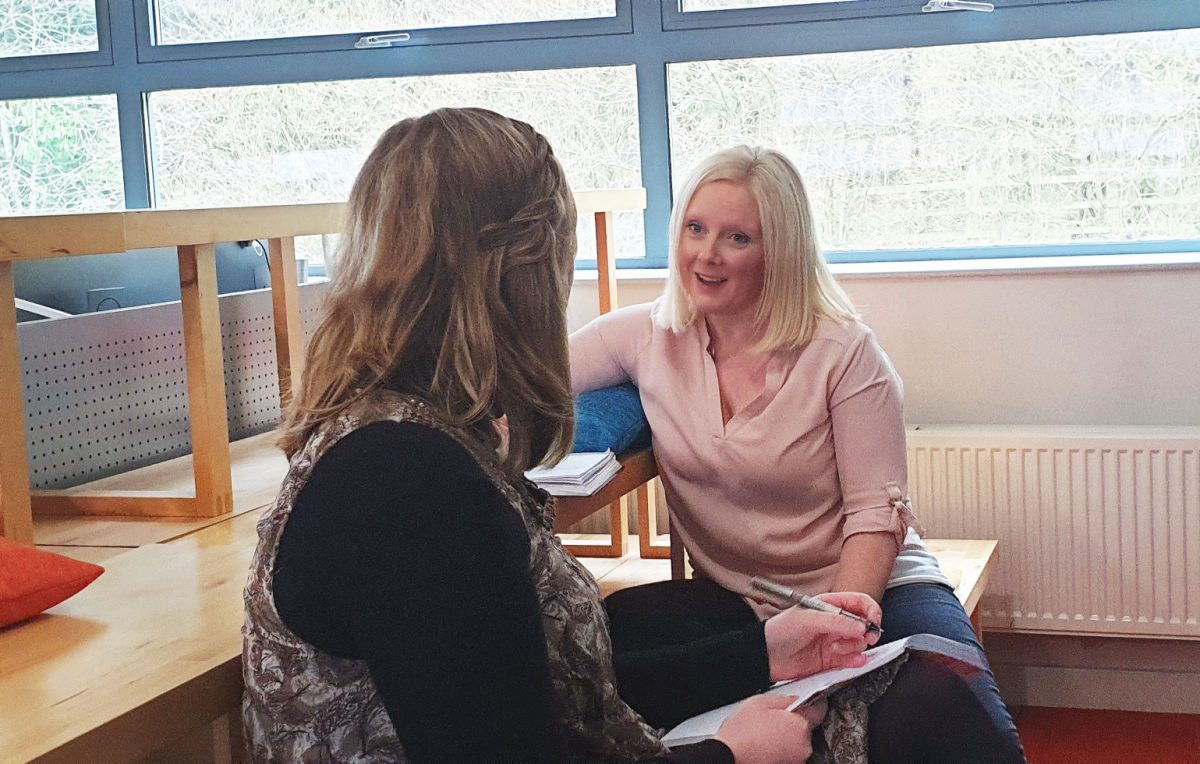
1pm Lunchtime coffee meeting in Starbucks round the corner with a contractor who we occasionally team up with to bid for new projects. We chat about potential opportunities and when they might come. Today I’m walking over to the shops afterwards to get some fresh air and buy some essentials. I find combining lunchtime break with a walk and some shopping is usually the best use of my time. I go to the supermarket to grab a chicken salad then the chemist to get some more formula for my youngest son who’s still on bottles.

2pm My email inbox is usually getting congested by this time if I’ve had a busy morning, with project query emails as well as those from colleagues, so I spend half an hour working my way through the most urgent ones while I eat.

2:30pm I need to put a fee proposal together for a new multi-disciplinary project, so calculate how much time it will need from various members of our team for the different stages before putting the proposal document together and emailing it out.

3:30pm Today I have a staff training planning meeting, deciding on the best strategy and priorities for ensuring staff are staying ahead of training requirements for their disciplines, pre-empting what we’re going to need to know and learn in the coming year. This is a good opportunity to catch up with colleagues in Glasgow for a chat too.

4:30pm We have a drawing deadline tonight for the university refurb project, showing the extent of demolitions required,  so I check over the drawings before they are sent out to the Project Manager (with a coffee and a biscuit which I probably shouldn’t be eating!).

5:30pm  After making sure the drawings went out OK I jump into the car to try and get home for six o’clock whenever I can. We sit down to dinner as a family at this time after my husband has collected the kids, so it’s a special time I try to make for the family. If I’ve been organised enough I’ll have something ready in the slow cooker, but today its left over spag bol and ice cream.

6:30-7:30pm is bath & bed time for the kids, then I tidy up the chaos of toys and dishes while my husband walks the dog. I’m doing some teaching and marking at the University Of South Wales tomorrow so I look through the student’s projects again to refresh them in my mind.

8:30pm I open my iPad in front of the TV with a camomile tea to go through some emails and do some doodles to get down some design ideas. We’ve been enjoying South Korean drama Vagabond on Netflix recently so we manage to get an episode of this in before bed. This part of the day is the most peaceful! After that I get a clean bottle and formula ready for the night feed that will inevitably come at around 2 or 3am then head to bed to get as much shut eye as I can before then!


 

I hope you’ve enjoyed seeing a snapshot of what a weekday looks like for me. Juggling it all has its challenges but I’m lucky enough to love my job (no, honestly!) so wouldn’t have it any other way 🙂

Quickfire Questions with Valerie Tsang

Valerie Tsang banner

Quickfire Questions with Valerie Tsang


Name
Valerie Tsang.

When did you join Austin-Smith:Lord?
October 2018.

What is your role within our Creative Collective?
Landscape Architect Assistant.

What are you working on at the moment?
Multiple project types from public realm and housing to education, all at different RIBA stages.

What inspires you most in your work?
Natural environment and cultural heritage.

What aspects of your work are you most proud of?
Knowing the positive contributions my day to day work adds to the environment that surrounds  everyday life.

What lessons have you learned in your work?
Ask questions!

What is your favourite place?
Anywhere with the blue sea. It brings a sense of calm but also represents adventure that lies beyond the surrounding different elements and wildlife.

What fictional place would you like to visit?
Laputa, an island in the sky from the Hayao Miyazaki movie.

Complete the following –  “I couldn’t get through the week without……..”
Ice cream.

If you could pick only one country to visit for the rest of your life where would it be?
Taiwan, because of the openness to the mix of cultures, all the elements nature has to offer, the friendly locals and the food.

Quickfire Questions with Jonathan Jones

Jonathan Jones banner

Quickfire Questions with Jonathan Jones


Name
Jonathan Jones.

When did you join Austin-Smith:Lord?
June 2015 (although I’ve been around since 2012 really if you count my post-Part 1 year!)

What is your role within our Creative Collective?
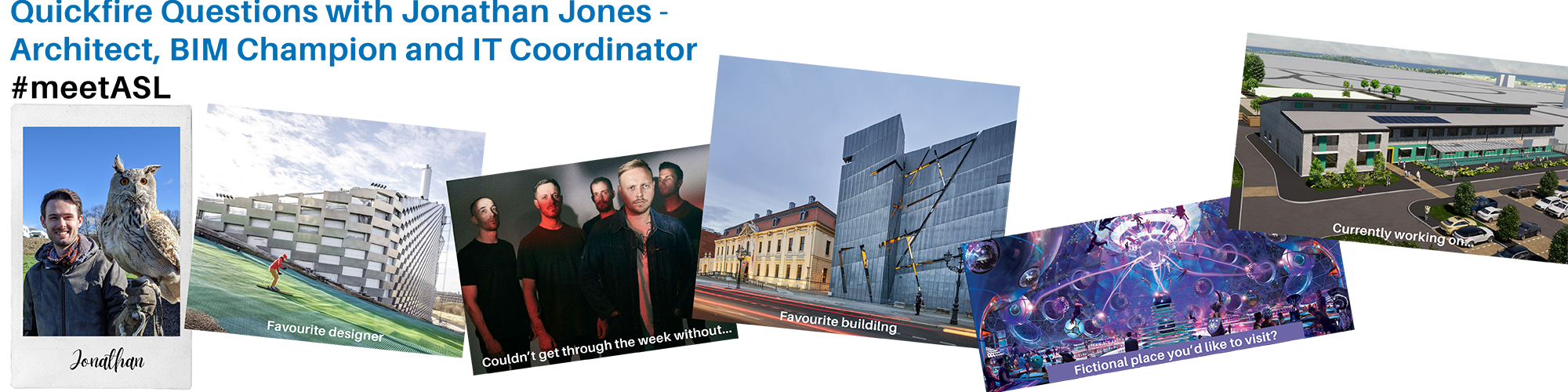
Architect, as well as the South’s ‘BIM Champion’ and IT Coordinator.

What are you working on at the moment?
Primarily several education projects covering multiple levels of education:

    • Ysgol Gyfun Gwynllyw, a Welsh Medium Primary School in Trevethin, which is nearing completion. A beautiful site, with stunning views of the Gwent valleys.
    • Maendy Primary School, our first Passivhaus Primary School, to be built in Cwmbran, which will feature incredible energy efficiencies and low-carbon construction.
    • Extension to Block C for Coleg Y Cymoedd’s Ystrad Mynach Campus, which will provide additional decorating bays for their existing offering
    • Sports Centre of Excellence for Coleg y Cymoedd, a new sports and teaching block enhancing their Nantgarw campus.

What inspires you most in your work?
Finding elegant solutions to the needs of clients, in order to produce buildings that not only exude quality, but provide spaces that are perfectly suited to the activities within.

What aspects of your work are you most proud of?
Driving forward the use of emergent technology, and pushing the use of parametric design through Revit across the practice. Whilst not specifically design related, I am immensely proud of the willingness of my colleagues to embrace tools like Revit and Twinmotion, which have enabled us to be not only more efficient in design, but democratize visualizing projects.

What designers / projects do you most admire and why?
Has to be Bjarke Ingels – the logical, step-by-step process by which they arrive at their designs is both fascinating and inspiring. Blending different typologies and breaking down conventional barriers through almost every project; who else would have thought to add an artificial ski slope to the roof of a waste-to-energy power plant?

What is your favourite place / building / landscape and why?
Whilst it’s a somewhat dark subject, I have to say The Jewish Museum, Berlin. I don’t think there’s a better example of architecture marrying the subject matter contained within as this. Symbolism is rife throughout, whether it be through inaccessible or invisible voids, or the undeniably poignant ‘Holocaust Tower’, the building is as much part of the exhibition as the collection itself. Every single space, light and finish feels as if it’s designed to specifically evoke something – and it does.

What fictional place would you like to visit?
The OASIS from Ready Player One – one of my favourite books, which became one of my favourite films. Being a massive self-confessed nerd, the virtual universe of pop-culture and gaming references has an undeniable draw for me. With the advent of an often mentioned ‘Metaverse’ we might not be far off that either, with some major Architecture practices already designing buildings for it…

What’s something you’re planning on doing in the next year that you’ve never done?
Wedding planning! Just over a year to go until the big day, so plenty to be done…

Complete the following –  “I couldn’t get through the week without……..”
Music. It may be a cliché, but I need a soundtrack to my life. Anything fast, heavy, and loud to keep the energy up – in fact my favourite band are a metal band called Architects! Fun fact: they were actually once reported to the ARB for misuse of the title, by someone with clearly a bit too much time on their hands!

RIBA Future Architects LDN / LIV

Banner

RIBA Future Architects LDN / LIV

In the spirit of one of our core guiding principles ‘Knowledge Sharing + Life Long Learning’ which seeks to champion knowledge sharing, mentoring and career-long learning towards continuous improvement, research and development, we are delighted to be an RIBA Future Architects Student Mentoring Practice 2021/22.

Mesha McManaman and Tope Balogun are mentoring students from University of Liverpool and Ravensbourne University respectively. They had introductory sessions with their mentees recently and are both raring to provide support for the next generation. The students will benefit from having an introduction to life in practice and receive one to one support. Mesha and Tope will undoubtedly also find this highly rewarding and beneficial.

Mesha says: “I am very honoured to be a part of the RIBA mentoring programme this year, and very much looking forward to influencing the next generation of architects from our local universities. The Future Architects scheme is a fantastic way to demonstrate the different skillsets required for daily practice life, as well as encouraging and supporting students as they begin to identify their own career goals and direction.”

The practice is also looking forward to developing long term connections with these schools of architecture to help shape and support our profession.

Quickfire Questions with Richard Cronin

Richard Cronin banner

Quickfire Questions with Richard Cronin

Name
Rich Cronin.

When did you join Austin-Smith:Lord?
August 1996.

What is your role within our Creative Collective?
Chief Operating Officer.

What are you working on at the moment?
Major transport and industrial jobs across the UK.

What inspires you most in your work?
The people around me. There are so many talented young folk in the Creative Collective I often just sit back and listen!

What aspects of your work are you most proud of?
Our transport and industrial back catalogue.

What lessons have you learned in your work?
To pick my battles and remember that the client is (usually) always right.

What is your favourite Austin-Smith:Lord project and why?
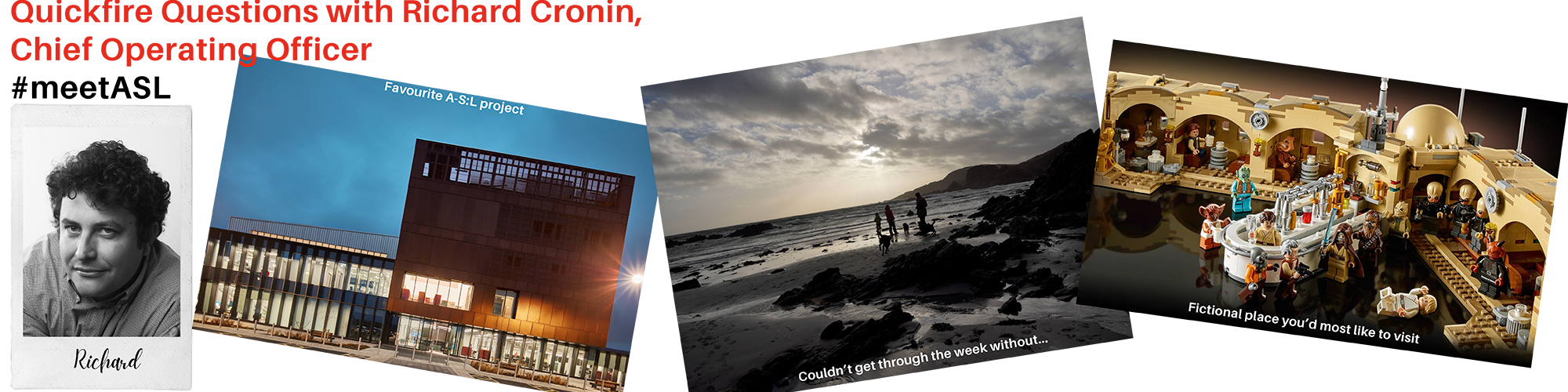
AMRC in Broughton. It was a great building to develop with Welsh Government and Airbus which was repurposed during the pandemic to develop ventilators, showcasing its flexibility.

What fictional place would you like to visit?
The Cantina Bar in Star Wars.

What is your pet hate?
Inconsistency.

Complete the following –  “I couldn’t get through the week without……..”
A walk with my family, dog and camera.

Quickfire Questions with Peggy Tsang

Peggy Tsang banner

Quickfire Questions with Peggy Tsang

Name
Peggy Tsang.

When did you join Austin-Smith:Lord?
September 2021.

What is your role within our Creative Collective?
Landscape Architect.

What are you working on at the moment?
Healthcare and education projects, including Ayrshire Hospice.

What inspires you most in your work?
Learning from my colleagues, and good team collaboration.

What is your favourite place/building/landscape and why?
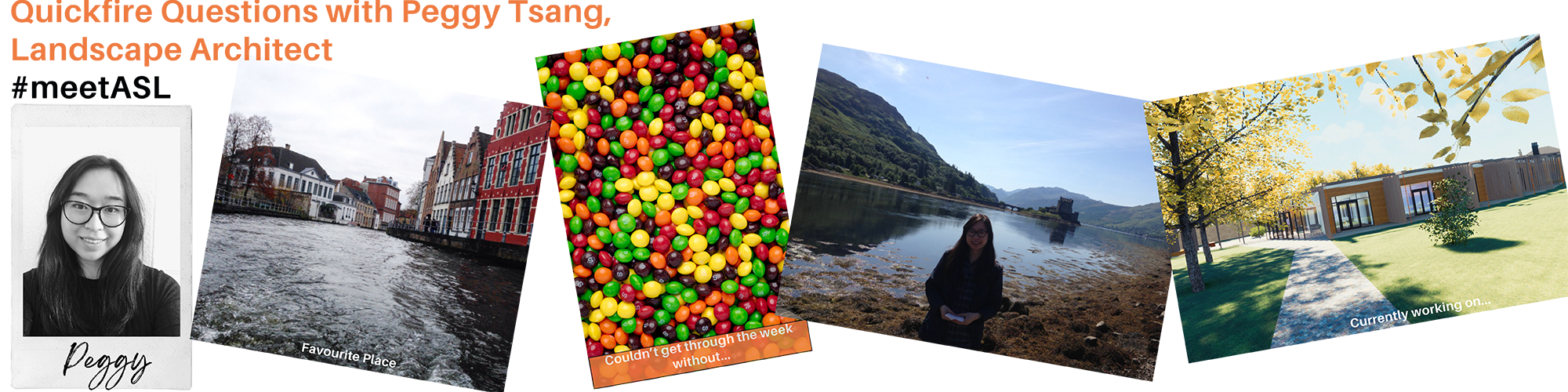
Bruges. Such a pretty and romantic city, plus it has great waffles!

What are the key issues facing our design professions in the 2020s?
As a Landscape Architect, people sometimes don’t know quite what we do! Our skills and qualities are sometimes overlooked in projects.

What aspects of your work are you most proud of?
Being able to contribute to local communities, and seeing people enjoying the space.

What’s something that recently made you smile?
Good food 🙂

What’s something you’re planning on doing in the next year that you’ve never done?
Getting married!

Complete the following –  “I couldn’t get through the week without……..”
My snacks.

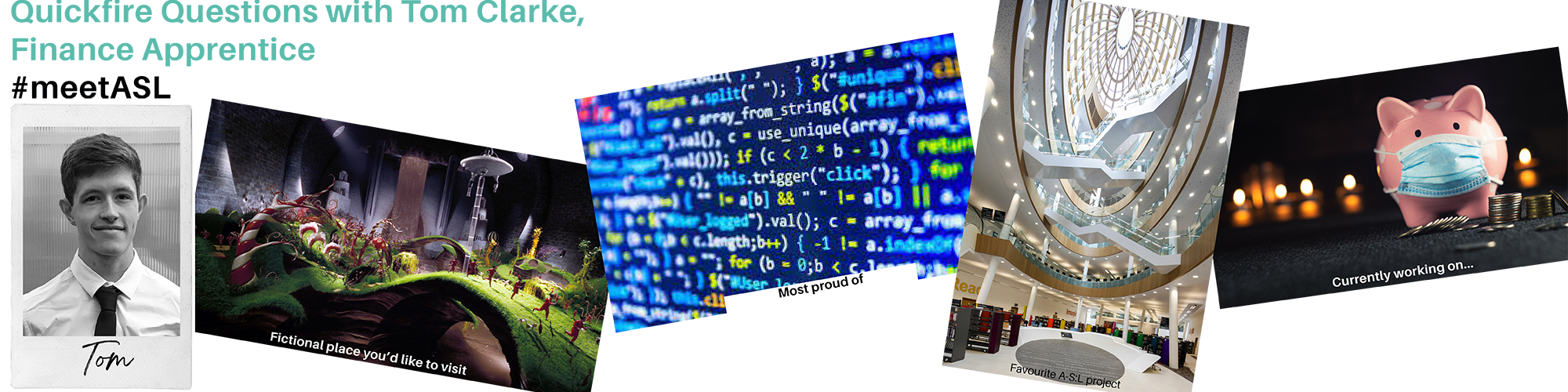
Quickfire Questions with Tom Clarke

Tom Clarke banner scaled

Quickfire Questions with Tom Clarke

Name
Tom Clarke

When did you join Austin-Smith:Lord?
September 2021

What is your role within our Creative Collective?
Finance Apprentice

What are you working on at the moment?
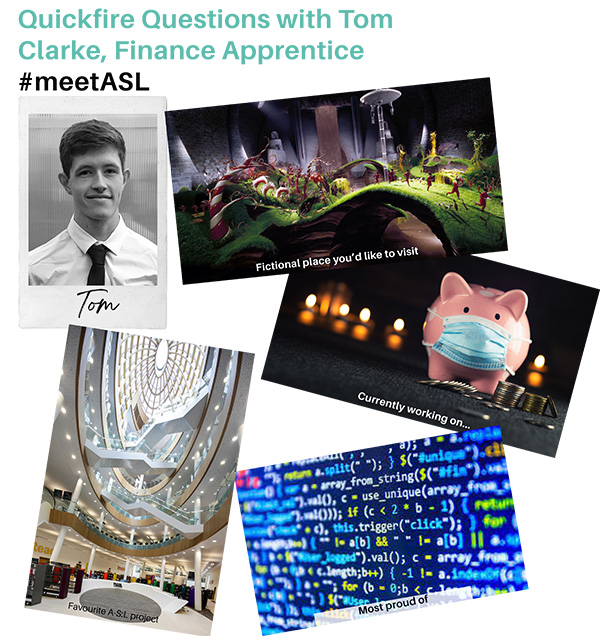
Chasing debt – the most interesting job…

What inspires you most in your work?
Learning new things

What aspects of your work are you most proud of?
Applied my coding knowledge from school to create macros within excel

What lessons have you learned in your work?
Office experience

What is your favourite Austin-Smith:Lord project and why?
Liverpool Central Library as it combines the old and new

What fictional place would you like to visit?
Willy Wonka’s Factory

What is your pet hate?
Numbers

Complete the following –  “I couldn’t get through the week without……..”
Asking Allan and Terence lots of annoying questions

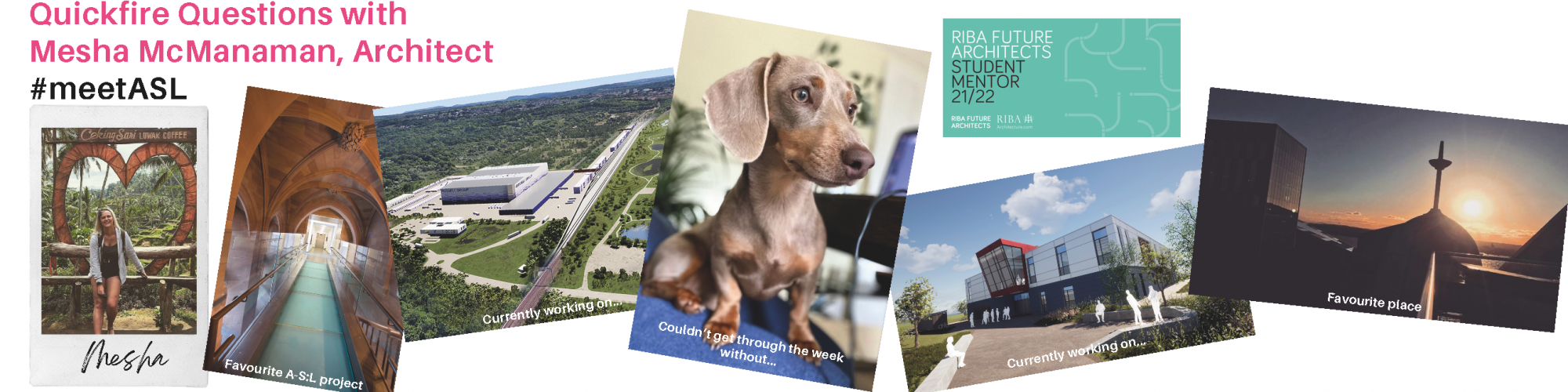
Quickfire Questions with Mesha McManaman

Mesha McManaman banner

Quickfire Questions with Mesha McManaman

Name
Mesha, or ‘Meesh’ to most.

When did you join Austin-Smith:Lord?
August 2015.

What is your role within our Creative Collective?
Architect. I am also a RIBA Future Architects Mentor and a CPD Coordinator.

What are you working on at the moment?
A real mixed bag at this very moment; jumping between Inverness Life Sciences and Innovation Centre, Glasgow District Regen Frameworks, been working up a walk-through video of a one-off house development and have a Logistics Hub currently in planning.

What inspires you most in your work?
My peers – we’re not called the “Creative Collective” for nothin!

What aspects of your work are you most proud of?
Problem solving – the satisfaction of finding a solution that has the end user at the forefront of the design… oh and then seeing it in use, functioning as intended. Bliss.

What is your favourite place / building / landscape and why?
I’m a sucker for a good sunrise/sunset. I think its the restorative effect, and how they somehow make time slow down. A great time for reflection.

What is your favourite Austin-Smith:Lord project and why?
Either Liverpool Central Library or John Ryland’s Library. I love it when old and new collide (or should I say, when it’s done well!).

What are they key issues facing our design professions in the 2020s?
Other than the obvious issues surrounding sustainability and the need to target net zero, I think competitive bidding is becoming far more aggressive, with a growing pressure to do more for less.

What’s something you’re planning on doing in the next year that you’ve never done?
Skiing and getting married (not at the same time!)

What’s the best advice you’ve ever heard?
“Nothing worth having comes easy” – Dad, repeatedly Est. 1991.

Complete the following –  “I couldn’t get through the week without……..”
My mini dachshund, Sydney. She is my little sidekick.