By Catherine Cosgrove, Sustainability Lead, Austin-Smith:Lord
To meet net zero emissions targets we will have to retrofit our existing buildings. But our built environment has developed over centuries, using many different materials and constructions. Retrofitting heritage buildings using modern materials can sometimes lead to unexpected and damaging consequences. Before we start to make any changes to our buildings, we need to understand more about how they perform.
Building constructions evolved over centuries to take advantage of the properties of the materials available. Construction methods using stone, slate, timber and plaster became increasing sophisticated through the 18th and 19th centuries. The constructions and materials used serving more than one purpose. As well as keeping the weather out, they helped to control the indoor environment through moisture management and ventilation. They rely on the properties of the construction materials to move moisture through walls, floors or roofs. Key elements include lime mortars, plasters and harling, rubble cores in external walls and “penny gaps” between roof sarking boards.
Through the 20th century the use of cement, steel, ready mixed mortars and plasters, mass produced bricks and roof tiles significantly changed the speed and consistency of construction. Construction methods and detailing changed to accommodate their different physical properties. Volume house building today uses off-site fabricated timber wall, floor and roof panels, sometimes pre-insulated, with plastic air-tightness membranes used to seal up any routes for draughts. These constructions take a different approach to moisture movement, preventing it through the separation of elements with ventilated and drained cavities, the use of plastic vapour barriers and by using mechanical ventilation to remove any condensation trapped inside the building.
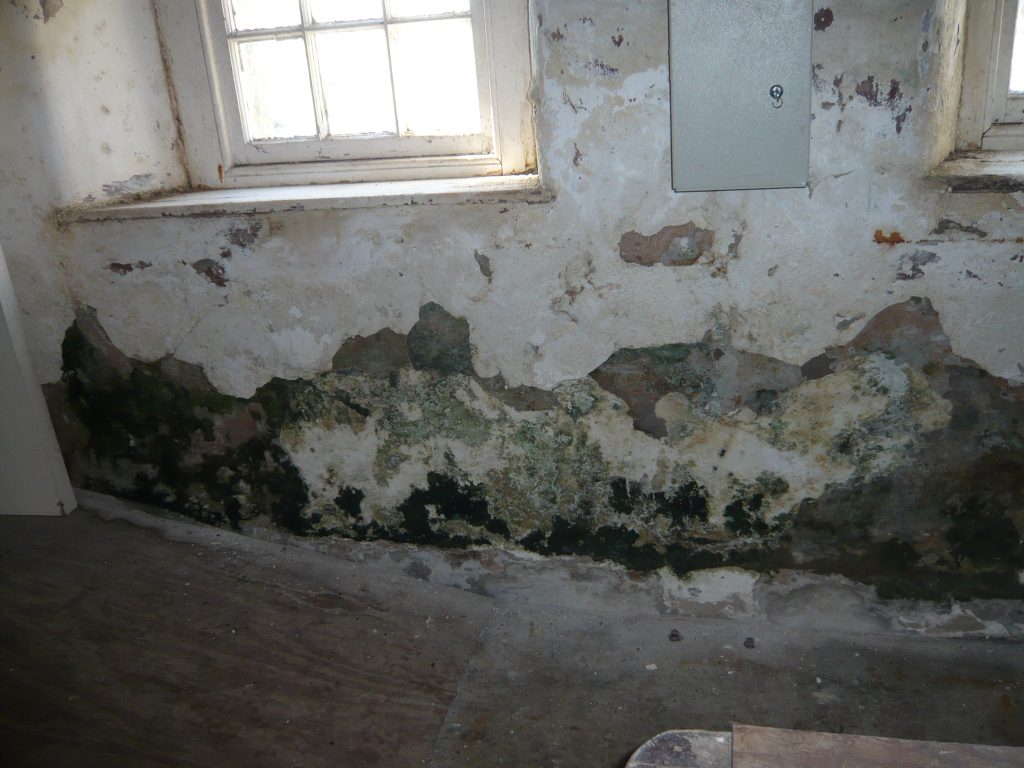
Dampness at base of wall causing mould growth
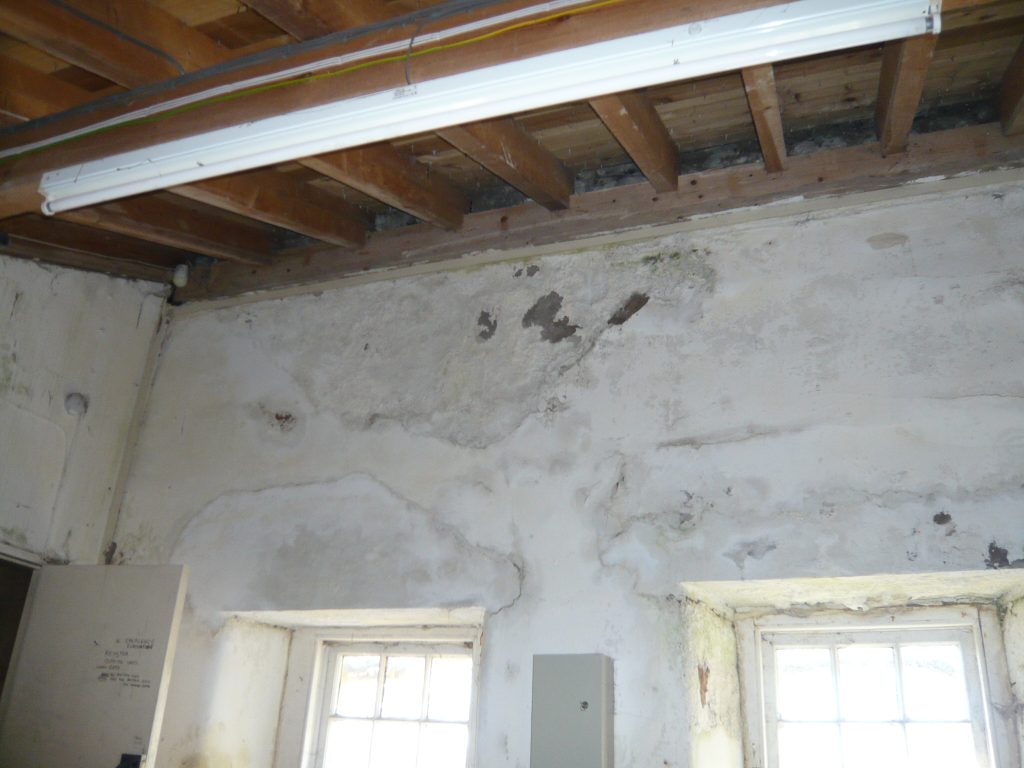
Internal finishes damage due to moisture trapped in wall
Traditional heritage constructions use materials that wick water away from the source using capillary action, suction and diffusion. The rate and direction of moisture movement can change due to weather conditions, pressures, heat sources and ventilation rates, all of which vary through the seasons of the year. In heritage buildings external walls tend to have reached a moisture equilibrium state, where they can cope with absorbing a certain amount of water regularly as long as they have the capacity to dry out. They can be significantly affected if they are exposed to more water ingress. While identifying gutter and rainwater pipe leaks are relatively simple, finding leaks in roofs and external walls is much harder. The material properties of these constructions can move water away from the source of any water ingress, making it difficult to find any underlying problem.
It is important to make sure that all sources of moisture ingress are repaired before starting retrofit works because of the potential long term damage that they can cause. These can have health implications for the building users as well as affecting the structure. Problems caused by water ingress can include wet rot, mould, algae and the leeching of salts through masonry. If you know where to look for problems then they can easily be repaired before causing significant damage. Common sources of water ingress include: blocked gutters; gutter leaks at joints; a build-up of ground levels or the use of hard landscaping at the base of the wall that direct rainwater into the wall; pointing repairs using a cement mortar rather than a lime mix, which traps moisture in the stones rather than allowing it to wick out through the joints; and using a cement-based render finish, which prevents moisture from being wicked away from the outside face of the wall.
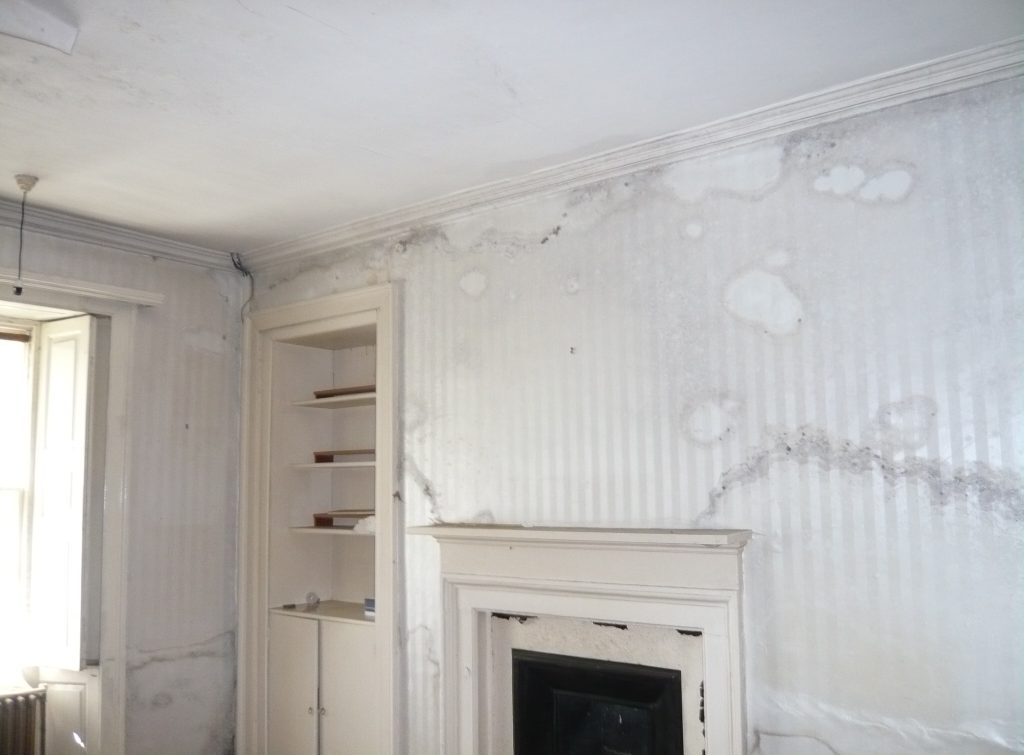
Internal dampness caused by chimney leaks
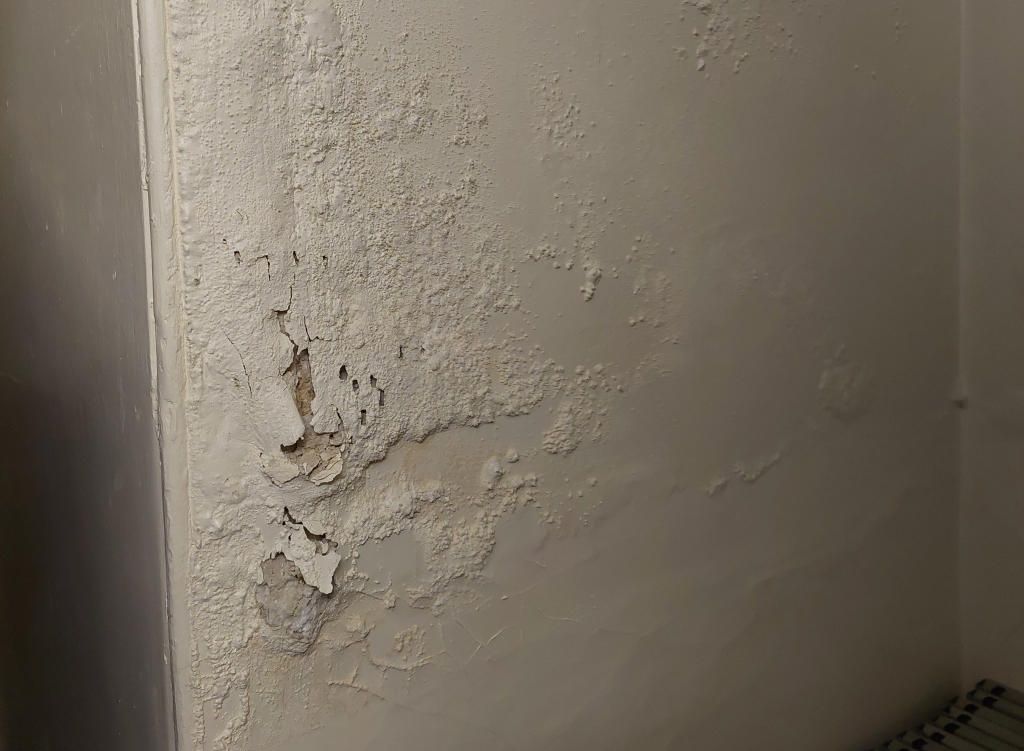
Dampness in wall affecting internal finishes
By adding modern materials to heritage buildings as part of retrofit works there is the potential to block the moisture management process, trapping moisture in a place where it can’t dry out and will eventually damage the building fabric. Two key steps to avoid this are to make sure that the retrofit materials are vapour open, e.g. using natural insulations, and that the constructions are in a good state of repair using materials and methods in keeping with the original construction.
For more information on this subject Historic Environment Scotland provide several publications: Technical Paper 37 Moisture properties of Scottish masonry materials; Technical Paper 15 Assessing risks in insulation retrofits using hygrothermal software tools; and Inform Guides on how to identify and repair dampness in buildings. The Under One Roof website (https://underoneroof.scot/) and Edinburgh World Heritage’s publication “Guide to Building Maintenance in a Changing Climate” are also useful guides to dampness problems and how they can be repaired.
This blog was first published in the RIAS Quarterly, January 2022.
When did you join Austin-Smith:Lord?
Originally 2016-18. Rejoined 2019.
What is your role within our Creative Collective?
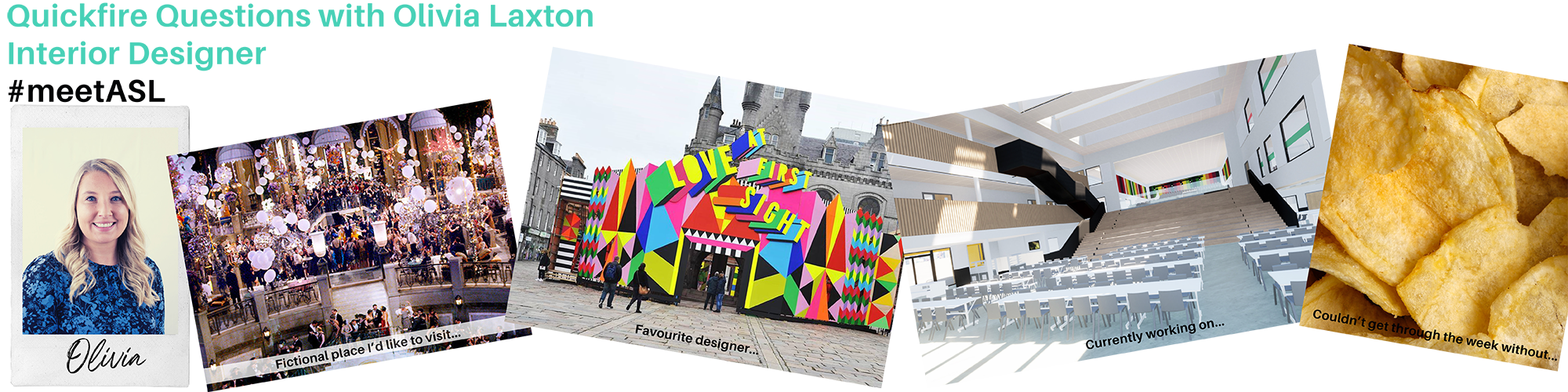
Associate Senior Interior Designer.
What are you working on at the moment?
Rougemont School, Fairwater Campus, University of Exeter Wellbeing Centre, Fitzalan High School.
What inspires you most in your work?
People!! Chatting with people, sharing around ideas, seeing how people work/behave within a space – those are the things that inspire me in my work.
What lessons have you learned in your work?
The biggest lesson I have learned in my work is that without collaboration, this job is nearly impossible! During lockdown when we weren’t able to share ideas and knowledge as easily as we could before, the role of designer became incredibly challenging, so it has made me forever grateful of the collaborative culture within Austin-Smith:Lord.
Which designers / projects do you most admire and why?
Morag Myerscough – her work always just feels so joyful and inspires me to have more freedom as a designer.
What are the key issues facing our design professions in the 2020s?
How do we design buildings to adapt at the same rate as our behaviour? This encompasses how we act sustainably as well as how we behave socially and culturally. It’s our responsibility as designers to design buildings that are fit for the future, but how do we design for the unknown?
What fictional place would you like to visit?
The Gatsby Mansion – I would have loved to have been around for the roaring 20s!
What’s the best advice you’ve ever heard?
Just do it…what’s the worst that could happen?
Complete the following – “I couldn’t get through the week without……..”
Crisps.
What is your role within our Creative Collective?
Architect.
What are you working on at the moment?
Life Sciences Innovation Centre in Inverness, and Ayrshire Hospice.
What inspires you most in your work?
The aspiration of making a fine public building for clients.
What lessons have you learned in your work?
Communication is key in both verbal and drawing format.
Which designers / projects do you most admire and why?
Renzo Piano, because his buildings speak to their surrounding in a humble but elegant way.
What is your favourite Austin-Smith:Lord project and why?
The restoration and refurbishment of Anchor Line. The building is absolutely stunning from the outside, and the refurbished interior further compliments the experience of dining in the restaurant on the ground floor.
What are the key issues facing our design professions in the 2020s?
The challenge to convince clients that retrofit is the new way to go for combating climate emergency, instead of a knock-down-and-build strategy. Many including Architects’ Journal are campaigning for retrofit, and it’s slowly gearing up across all professions in the construction industry.
What’s something you’re planning on doing in the next year that you’ve never done?
Explore North America and visit major cities like New York, Toronto, Los Angeles…
What’s the best advice you’ve ever heard?
See the world before you design the world.
Complete the following – “I couldn’t get through the week without……..”
Social media.
When did you join Austin-Smith:Lord?
September 2018.
What is your role within our Creative Collective?
Head of Conservation.
What are you working on at the moment?
Old College Aberystwyth, Coliseum Theatre, Caerphilly Castle, Woodchester Convent, Bexhill Town Hall, Newport Transporter Bridge.
Which designers / projects do you most admire and why?
Carlo Scarpa. His understanding of history, space, materiality and technique created buildings that are timeless.
What is your favourite place / building / landscape and why?
My favourite places seem to change depending on what place or site I have visited most recently! But the two experiences that have stayed with me are coming over the bridge and seeing Hampton Court Palace for the first time, and seeing the Louvre from the Carrousel. Both are instantly identifiable and the Lescot Wing at the Louvre in particular was incredibly influential on later French architecture.
What is your favourite Austin-Smith:Lord project and why?
The Great Pagoda at Kew. It was such a well-researched and executed project, it’s hard not to admire the work that went into it which shows in the end result.
Which of Austin-Smith:Lord’s guiding principles do you most relate to, and why?
Knowledge sharing and life-long learning. We constantly strive to learn which benefits us as individuals and as a practice, and the clients and communities we work with. Knowledge sharing allows us to learn from each other, find better ways of doing things and I believe it fosters strong relationships.
Which fictional place would you like to visit?
I think Willy Wonka’s Chocolate Factory would be a great day out.
What’s something you’re planning on doing in the next year that you’ve never done?
Buying a house I hope. I’ve always put it off but I’m finally content to say I am where I want to be.
Complete the following – “I couldn’t get through the week without…”
My family. My nephews in particular allow me to be scruffy, silly and forget the serious stuff we all have to deal with in life.
We were delighted to have Piotr join our Austin-Smith:Lord Cardiff studio for his Part 1 Summer Placement from May – August. We caught up with him before he left for a well-deserved vacation.
Piotr, Can you tell us a bit about yourself?
I came to the UK from Poland to study architecture at the Welsh School of Architecture, where in October I’ll start my third and final year of the BSc course. In my free time, I enjoy skiing and taking photos with my film camera.
How did you come to spend your summer placement at A-S:L?
My tutor in my second year of university was Neil Farquhar, Architect at Austin-Smith:Lord. I asked if any summer placements were available and, following an interview, I was offered a 3-month placement for the summer.
What have you worked on during your time at Austin-Smith:Lord?
I’ve spent a lot of my time working on Swansea Community Hub, a project in the heart of Swansea where Austin-Smith:Lord are sustainably transforming a vacant BHS department store into a vibrant service centre and library. I developed models for this project on Revit, attended client meetings and site visits, and compiled the Stage 3 report.
I’ve also worked with Austin-Smith:Lord’s Conservation Team on Aberystwyth University’s Old College redevelopment, which has just started on site. The redeveloped Old College will provide a major centre for learning, heritage, culture and enterprise.
Another project I’ve been involved in is Bexhill Town Hall, where Austin-Smith:Lord are redeveloping the Town Hall and constructing a new civic centre. I carried out some Revit modelling for this project.
Images: Swansea Community Hub
What have you enjoyed most about your time with us?
I’ve really enjoyed the site visits, where I can see projects I’m working on in real life and understand them better. It was very interesting to experience first-hand different aspect of architects’ work, from interiors and technical design to conservation.
I’ve also enjoyed being in the Cardiff studio, being part of the team, learning from everyone and picking up lots of useful information and tips!
Piotr on-site (third from the left) at Aberystwyth Old College to mark the removal of the first slate from the old University Estates building
What are the key things you’ve learned that will be of most use to you?
I’ve learned about the coordination and communication process between various design team members which I’m sure will be invaluable to me in future. Working on projects like Swansea Community Hub has been great in helping me to hone and improve my Revit skills, as well as my knowledge about the design process.
I’ve also learned how to use TwinMotion Software, which I hadn’t used before I joined Austin-Smith:Lord, and managed to produce quite a few nice visualizations I’m very proud of!
What are your ambitions for the future?
I’m starting my final year in October, so my aim is to graduate with a good result and to continue developing my architectural skills, particularly in the area of public projects which I had a chance to get to know better at Austin-Smith:Lord.
I also plan to make time for my other passions, like photography and skiing, to help me relax and be ready for new challenges.
Restoration of the Old Grange Ruin and Brockhill Bridge
By Rob Firman, Director, Austin-Smith:Lord
Austin-Smith:Lord has been providing Conservation Architecture advice to the Ministry of Justice Estates Directorate project team through Mott MacDonald for the restoration of the Old Grange Ruin and Brockhill Bridge at Hewell Grange in Worcestershire since May 2017.
The two elements of the project have fascinating histories and presented exceptional challenges to the project team as we worked with the Contractor to complete the restoration works. Set within an 18th Century Capability Brown landscape that had been modified by Humphrey Repton early in the 19th Century, and both listed Grade II, their restorations required sensitivity and a lot of patience.
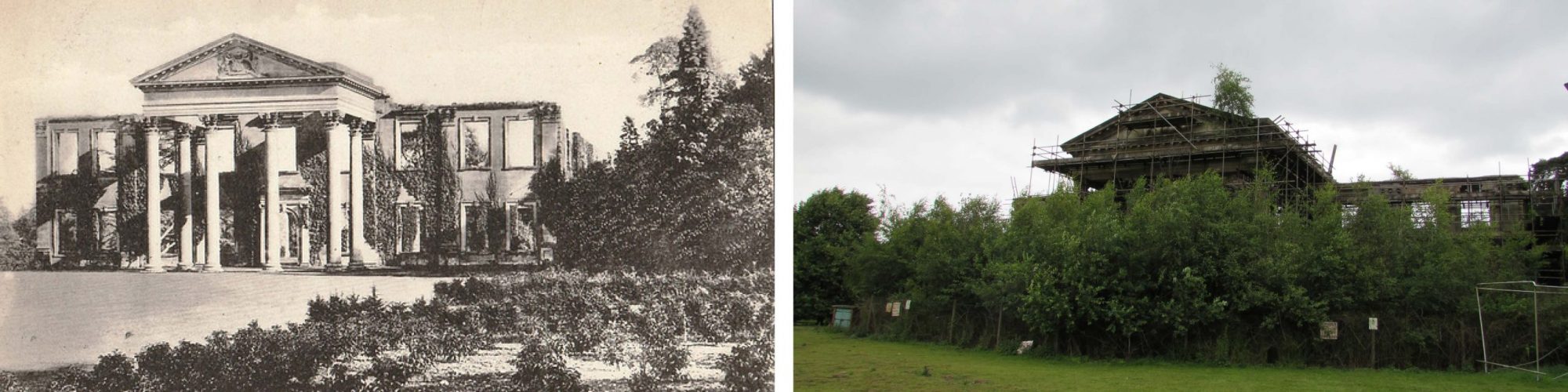
The Ruin had been unattended for over 25 years when the project to restore and conserve it commenced and it was at significant risk of collapse, extremely overgrown with invasive and damaging vegetation and inaccessible for detailed inspection to ascertain its true condition. The restoration project aimed to return the structure to a stable and self-supporting condition and leave the fabric of the remaining walls and features sufficiently repaired to minimise ongoing maintenance in the future.
The Bridge had partially subsided on one side as the water running over the adjacent weir had undermined one of the abutments and the twisted structure and deck required stabilisation and straightening. The restoration works aimed to realign and stabilise the bridge structure.
The Ruin
Postcard of the ruin, early 20th Century
The Ruin at the commencement of the restoration project, June 2017
The original house at Hewell Grange dates from around 1705 and was adapted and modified several times in the late 18th and early 19th centuries until it reached its final form in 1815. Capability Brown carried out works to the grounds in 1760 and 1761 and in 1811 Humphrey Repton was appointed to re-design the grounds. Hewell Grange can therefore boast of having England’s two greatest landscape designers create its grounds and gardens and this undoubtedly contributes to them being listed Grade II*.
The ruin we see today was created by a fire that largely destroyed the house in 1889. There is a suggestion that the fire was caused by fireworks being set off to celebrate the presence of the Shah of Persia at the Estate but the reality is probably less exotic. A new house was already under construction when the original one burned and it was decided to leave the ruin as a preserved object in the landscape.
In 1945, Hewell Grange together with 5,500 acres of land was placed on the market to settle death duties and in 1946 it was announced that the mansion and grounds was to become an experimental Borstal. Stewardship of the property passed to the Ministry of Justice from then and remains part of the MoJ property estate to date. In the early 1990s the condition of the ruin was causing concern and a scaffold frame was built to support it. The ruin and immediate perimeter was secured behind a fence to prevent access and prevent the risk of accidents caused by falling stonework and the ruin remained in that condition for nearly 30 years.
In 2017 Austin-Smith:Lord joined a team led by Mott MacDonald to assist in proposing a methodology for the stabilisation and restoration of the ruin. The site was completely overgrown with self-sown trees and ivy covered every visible surface of the structure. It was a veritable self-supporting eco-system! In early 2018 Vinci Construction was appointed as main contractor to deliver the stabilisation and restoration works.
Over the last 4 ½ years the process of restoration has been impacted by birds nesting on and bats roosting in the stonework and by the Covid-19 pandemic. In the spring of 2020 one of the free-standing sections of wall on the southern elevation collapsed and consequently all parts of the ruin in that area had to be taken down to ensure safety of the workforce and carefully rebuilt later. Throughout the construction period the restoration work has been painstakingly executed by a team of specialist stonemasons and bricklayers and Austin-Smith:Lord has visited the site on a monthly basis to monitor progress and quality in our role of Technical Advisor for Conservation on behalf of the MOJ client.
By the summer of 2022, works have been completed on the majority of the ruin structure with rebuilding of the collapsed section at the rear ongoing and repairs to the portico structure at the front about to commence. There will be many more challenges to face to ensure that the whole ruin will be standing for future generations to enjoy but the wait will be worth it.
The Ruin at June 2022
Brockhill Bridge
As part of the redesign works he was commissioned to carry out in 1815, Humphrey Repton proposed construction of 2 new bridges, one of which is now known as Brockhill Bridge. It was constructed around 1820 to his design using cast-iron from Horseley Iron Works in Tipton. It appears to have been installed as a feature in the landscape to cross the lake at a narrow point which allowed views down the lake to a boathouse and Hewell Grange house beyond. Primarily used as a footbridge it has never needed to be upgraded and is therefore an unaltered example of its type, closely reflecting the design of cast-iron bridges dating from the end of the 18th and early 19th century, of which only a few survive. It is listed Grade II.
As part of the installation of the bridge a cascade was constructed just north to provide a further landscape feature, as well as the sound of rushing water while viewing the house and grounds.
The Bridge and cascade at May 2021, prior to commencement of the stabilisation project
The Bridge at July 2022
The bridge had not been maintained for a considerable period of time and had noticeably fallen into disrepair with the area around it becoming heavily overgrown. The Austin-Smith:Lord and Mott MacDonald team working on the Ruin project was invited to make recommendations for the stabilisation of the bridge in October 2020 such that the works could be executed in parallel with the works at the Ruin.
A report on the bridge in November 2020 noted ‘a combination of water erosion from overspill of Brockhill Weir and invasive tree root action at the west abutment have resulted in a destabilised arch. Relative displacement at the west abutment in three-axes have allowed the northern arch to spring. Consequently, the bridge deck now lists towards the failed northern arch, the cast “crown-tie” at the crown of the arch has failed, along with the north parapet railings where the horizontal chords of the parapet have buckled in compression along with individual vertical balusters shearing in tension’.
A detailed program of works comprising 20 phases was devised by specialist sub-contractor Freysinnet to stabilise the bridge, including dismantling and reconstructing the western stone abutment, supporting, removing defective elements for replacement, jacking the failed northern side to the horizontal, installing a recast crown linkage, and removing supports, and some minor reinforcement.
The works commenced on site in spring 2021 and were completed in summer 2022. The bridge is now levelled and square and has a new resin-bonded gravel deck to enable pedestrian traffic to use it once again. The works provide for the long-term preservation of the bridge, ensuring its heritage significance is retained, as well as its contribution to the heritage significance of the wider Hewell Grange Park and Garden.
The combination of the restoration and stabilisation of these two significant heritage assets in an outstanding heritage landscape has provided the Austin-Smith:Lord Conservation team with some of its most challenging and rewarding experiences and following our previous work with heritage assets in special landscapes at locations as diverse as Lews and Portencross Castles in Scotland, Caerphilly Castle in South Wales and The Great Pagoda at Kew Gardens reinforces our expertise for such unusual projects.
Our next project of this type is at the Grade I listed Transporter Bridge in Newport, South Wales, due to commence restoration work later in 2022 and complete in 2024. It will ensure we continue to develop our skills and expand our portfolio of conserving unique heritage asset restorations in special locations.
Shakespeare North opens its Doors to the Community
By Mike Yates, Director, Austin-Smith:Lord
Shakespeare North Playhouse opened on 15 July. First through the door was three year old Stevie Arabella perfectly embodying the optimism, hope for the future and local community as she ran joyously through the foyer. The weekend was an open invitation to the local community to embrace their new venue. Over 10,000 visitors took the opportunity to take part in free workshops and activities, enjoy free performances and explore the theatre, Sir Ken Dodd Performance Garden, Studio, foyers, café and bar.
On Friday evening “All the Joy That You Can Wish”, a ceremony and performance by Slung Low, was a glorious occasion. Taking part in the procession were local community groups: Act For Action, Al’s Activity and Respite Centre, Bryer Road Coffee Group, Imaginarium Theatre, KIER, The Lee Cooper Foundation, Merseyside Black Lives Matter Alliance, Prescot Cables F.C, SHARe Knowsley – Support & Help for Asylum seekers and Refugees, VIBE Knowsley and Shakespeare North Community Curators. It was wonderful, welcoming and inclusive.
Slung Low performing “All the Joy That You Can Wish”
From the outset Shakespeare North Playhouse by Helm Architecture and Austin-Smith:Lord has been a project of international significance that is firmly embedded in the local community. All Prescot is now a Stage; performance, storytelling, learning, having a go and hanging out will pervade the streets, the Piazza, Performance Garden and recreated historic “Cockpit in Court” theatre which can also transform into a contemporary space. This is a place of aspirations, dreams and entertainment.
Imaginarium – Local theatre and Community Arts Group in the Procession
Ashleigh Nugent the first performer in the “Cockpit in Court” theatre
The brilliant local author, playwright and rapper Ashleigh Nugent is a self-confessed local scally who realised his own dreams through his “Hero’s Journey”. Ashleigh now runs Rise Up, working with prisoners to find their own story and get the most out of life. Interviewed on Front Row on Radio 4 he said as soon as he heard about the project he knew he had to get involved. So how fitting that he co-curated the opening weekend and performed the first piece of Shakespeare on stage on Saturday night at the opening ceremony alongside a free form rap incorporating words used in the opening speeches which was breathtaking.
The exciting opening season includes; A midsummer Night’s Dream, A Christmas Carol, Serious Nonsense Festival, An Evening with Johnny Vegas, Rubbish Romeo and Juliet and As You Write It, a collaboration between Shakespeare North Playhouse and BBC’s The One Show to find and showcase new young writers. There is much more besides, and all details are on the Shakespeare North Playhouse website.
Café and Bar
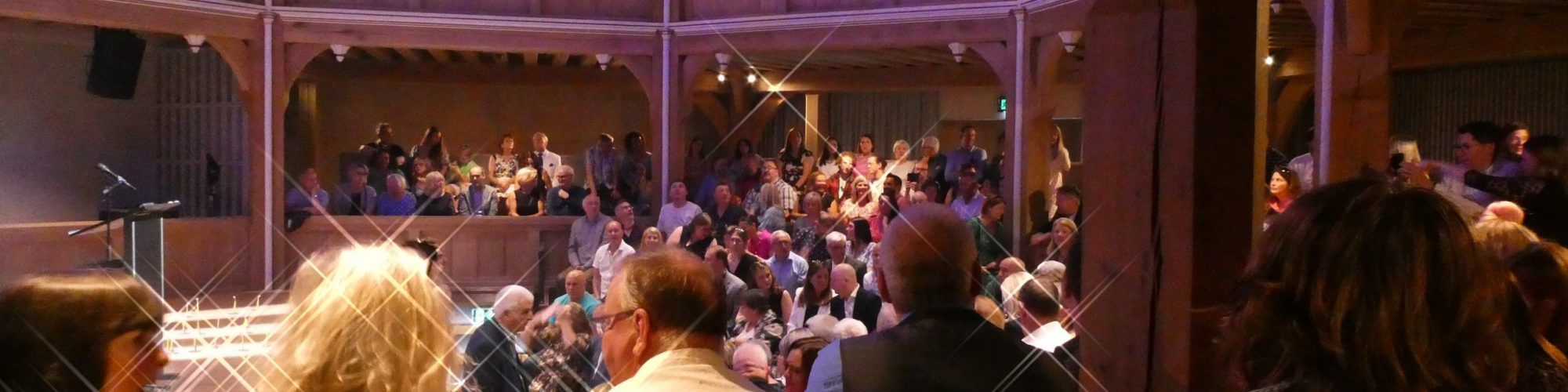
“Cockpit in Court” theatre – opening ceremony
This was a levelling up project conceived before the term was first coined. It is a microcosm of the healing process that this nation needs after years of divisive politics. This has been evident in its’ bringing together people and communities from across the social and cultural spectrum. It promises to be a place where the social and performance spaces become a melting pot of chance meetings, ideas and fun with a rich mix of cultures.
The opening weekend was a great success. If you have not yet had the opportunity to visit please support this unique venue very soon.
What is your role within our Creative Collective?
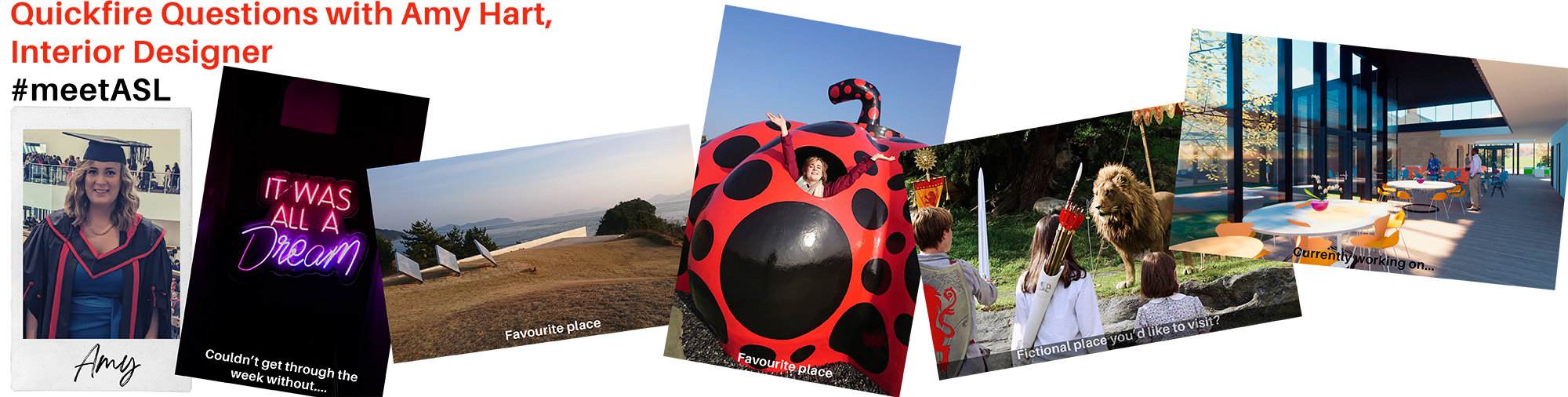
Interior Designer.
What are you working on at the moment?
A number of Scottish projects ranging between healthcare and commercial spaces. This includes Ayrshire Hospice and the refurbishment to Allan House.
What inspires you most in your work?
Designing spaces that are practical and creating healthier environments for users.
What aspects of your work are you most proud of?
My time management and attention to detail.
What lessons have you learned in your work?
That changes will always happen, but it’s a part of the journey to achieving the final outcome.
What is your favourite place / building / landscape and why?
My favourite place I’ve visited is Naoshima in Japan. It’s an inspiring little art island, which has art museums and art installations dotted all around.
What fictional place would you like to visit?
Narnia.
What’s something that recently made you smile?
Being able to have a graduation that was postponed due to Covid. I finished my degree in 2020, so to celebrate with friends and family on 17th March 2022 was a special time for me.
Complete the following – “I couldn’t get through the week without…..”
My beauty sleep.
By Kate Thomas, Director and Head of Interior Design at Austin-Smith:Lord
Performance Arts is a strong and vital industry within the UK economy. Amongst other notable recent developments, the growing UK TV industry and the resurgence in Arts activity since the easing of pandemic restrictions are feeding into this. Wales in particular is enjoying a surge in investment in the TV and film industry including major Hollywood film productions, with a growing recruitment programme in this sector. The leisure sector is ‘on the up’ coming out of the pandemic, as is being published by financial forecasters such as Deloitte. This is intrinsically linked with Performing Arts which occupies a substantial chunk of leisure economic activity between theatre, TV and film and cinema which run alongside and intersect with other leisure sectors such sport, travel and food and drink. Preparing the next generation for immersion in the Performing Arts industry, from the perspective of performers, production roles and of course audiences, is certainly key to the future success of this sector with all of the enriching cultural and economic benefits it brings.
How are we currently achieving this preparation in schools, colleges & universities across the UK and how will this increasingly affect required facilities improvement and building design going forward?
Schools:
Nationally across the UK the expectation of pupils and staff in terms of the quality and professionalism of performing arts leaching spaces and equipment is growing at pace, soon to catch up with facilities historically only expected in professional settings. In schools, a few extra lights and modular stage blocks in the school hall is being leapfrogged with more professional lighting rigs, flexible spaces allowing various performance configurations and staging, bespoke drama and recording studios , dance studios with sprung floors, acoustically tuned spaces, more accessible changing facilities, and the list goes on.
Fitzalan High School in Cardiff is currently in construction. Austin-Smith:Lord has put bringing the school together for Performing Arts and presentations to the front and centre of the design, with an innovative flexible heart space for different scales and types of event with consideration for cohort numbers, whole school events, sightlines, lighting and acoustics. There is a bespoke audio visual system within this space which responds to various configurations of conjoining spaces, allowing immersive and shared experiences wherever you are located. Amongst other specialist facilities, the school will boast a flexible dance and activity studio with professional grade finishes, a dedicated drama studio, recording studios, music teaching, rehearsal and performance facilities. A dedicated steel pans room is located at the front of the building to showcase this particular specialism within the school. An exciting addition to the Performing Arts provision is an ‘immersion room’ using state of the art sound and projection equipment to create various 3D environments for students to experience virtual worlds in real time.
It is definitely important to understand what learning outcomes schools need to provide for pupils to fulfil the curriculum requirements for Performing Arts, as this is the backdrop which points to the challenge of the level of facilities that will be required in schools going forwards.
Fitzalan High School
In Welsh schools the new Curriculum coming in this September for ages 3-16 names Expressive Arts as one of the 6 key Areas of Learning & Experience. This spans five disciplines: art, dance, drama, film and digital media and music. In Scottish schools a similar Expressive Arts curriculum was launched with the current curriculum in 2019. The Welsh & Scottish drama curriculums are arguably more detailed and explicit in the requirements for Performing Arts than in England, and schools are designing their new lesson plans to make best use of the facilities at their disposal to achieve this as best they can. The new curriculums are aspirational in the learning outcomes within the subject, requiring familiarisation with digital platforms, as well as wide ranging roles within the industry. To illustrate this, in Wales, the requirements for drama alone (as separate from art, dance, film and digital media and music) include “plot, character, thought, relationships (which encompasses interaction), tension, focus, place, time, language, voice (which encompasses accent, diction, pitch, tempo, pauses), movement (which encompasses gesture, facial expressions), proxemics, atmosphere, mood, symbols, design which encompasses stage lighting, sound, set, hair, make-up, costume, script writing, directing and stage management, comedy, tragedy, tragicomedy, farce, musical theatre, melodrama, mime, physical theatre”.
Clearly some of these parameters require specific physical facilities and spaces. Going forward, facilities in Welsh & Scottish schools for this part of the curriculum should and will therefore be raised in priority beyond where they have historically been. Improving, refurbishing and extending facilities in existing schools and pushing the boundaries of design in new build schemes to give better learning opportunities will come together to achieve this.
In English schools, performance or drama as a subject doesn’t have its own section in the National Curriculum adopted in 2013. Instead it is a statutory part of English. As such the Spoken Language section reads as follows: “All pupils should be enabled to participate in and gain knowledge, skills and understanding associated with the artistic practice of drama. Pupils should be able to adopt, create and sustain a range of roles, responding appropriately to others in role. They should have opportunities to improvise, devise and script drama for one another and a range of audiences, as well as to rehearse, refine, share and respond thoughtfully to drama and theatre performances.” It is fair to say that there is flexibility in the interpretation of these comparatively inexplicit guidelines so schools vary widely in the facilities they offer to achieve them. This has led to a wide variety in the way in which schools fulfil their obligations within the curriculum, and inconsistency in the quality of facilities. Going forwards there will definitely need be a drive for more consistency across schools and augment the facilities in those with more a basic offering in line with the more advanced and newer schools through refurbishment and extension.
Further & Higher Education:
In Further and Higher education settings the specialist facilities for Performing Arts qualifications need to replicate those in professional industry environments to properly prepare and train the students technically. Recreating professional environments has the added benefit of attracting partnerships with external stakeholders within the professional industry who come and work and perform within the facilities which is a fantastic benefit to the staff and students. There has long been a drive to reinforce the connection between business, local communities and education establishments. This model has been pushed over recent years in management schools with business and entrepreneurship hubs being located on campus, linking industry investment and learning. But there is huge untapped potential to further this initiative within the Performing Arts sector. Raising the aspiration of facilities within education settings without doubt opens doors and exciting opportunities in the arts industry for students and attracts external investment – a model perfectly demonstrated by The McMillan Theatre at Bridgwater College designed by Austin-Smith:Lord. Performing Arts facilities within schools, colleges and universities are a great opportunity to do this and crucially can certainly bolster business plans for capital projects. I visited the McMillan Theatre recently to see how well it is ‘performing’ in a hindsight review. The building is bringing revenue to the College and attracting bigger and bigger shows. By day it is a teaching theatre for drama, production, live event management & theatre technicians. It also has a high specification dance studio with a sprung dance floor. By night it is the town’s theatre receiving touring shows, musicians, comedy and more.
McMillan Theatre, Bridgwater College
Much of the success has been down to the high specification of the auditorium both in terms of technical theatrical performance and the look and feel of the room which rivals the best provincial theatres. It is also down to the flexibility built into the space, with a proscenium arch which can fold away making the stage part of the room, an orchestra pit which can be infilled and curved stalls seating which retracts into the wall behind for flat floor events, acoustics designed to a wide spectrum of events and accessibility for those with disabilities. It has stood the test of time for both college and community use. It is an impressive facility for students to have as their classroom and as such is attracting great numbers of course applicants, as well as a growing list of high profile touring shows. Performers love the intimate design of the 350 seats, with even the upper tiers of seating feeling close to the stage. It is used for balls, cabaret, standing rock concerts for 450 people. The variety of uses has bolstered the business plan and augmented the college curriculum, so bringing the two worlds together has been a huge success story.
Education in professional performing arts settings:
As Architects, Interior Designers and indeed Landscape Architects specialising in design for both education and the professional performing arts sectors Austin-Smith:Lord is fairly uniquely placed to cross pollinate experience and knowledge between the two sectors of Education and Performing Arts.
We eagerly await the completion of Shakespeare North, our latest theatre project. We have many exciting education schemes at various project stages from conception to completion, and what has triggered this thought piece is our growing portfolio of designing education facilities within performing arts buildings and vice versa.
Birmingham Royal Ballet Refurbishment
We have worked with Birmingham Royal Ballet over recent years to refurbish then extend their training facilities, including new community changing facilities for school children to come for dance training sessions in the exciting and inspiring surroundings of a professional dance environment. The scheme allows for public benefactors to come and watch rehearsals behind the scenes and feel fully involved in the process. The benefits of engaging with the community and education in this way have been great and have raised the profile of the company locally and nationally.
The design challenge:
Pressure on budgets and available space means intelligent flexible design is key to providing the best possible facilities to inspire the next generation of Performing Arts professionals. Spaces that can transform in scale, acoustics and feel bring great value. This has to be balanced carefully against the need for rooms to be bespoke designed for individual purpose, such as specific acoustic and equipment requirements in designated spaces like recording studios. We predict that virtual reality technology and increased IT integration will become key to this in the future, allowing spaces to be digitally transformed as well as physically. Indeed, understanding the latest developments in the professional Arts industry as well as current drivers in educational pedagogy and educational curriculum requirements is the key to success in blending the two sectors to the benefit of all.
If you wish to discuss any of our past projects, or benefit from our experience in a future project, do get in touch.
What is your role within our Creative Collective?
Director, and Arts & Culture / Heritage Sector Lead.
What are you working on at the moment?
A range of small projects in Listed Court buildings.
What inspires you most in your work?
Achieving unexpected outcomes that in turn inspire our clients.
What lessons have you learned in your work?
You need a lot of patience to specialise in arts, culture and heritage projects.
What is your favourite building?
The Basilica of the Sagrada Familia, Barcelona. Seeing it as a 10 year old boy showed me my path to architecture. I have visited it every 5-10 years over the last 50 and I hope very much to live long enough to see it finished.
What is your favourite Austin-Smith:Lord project and why?
Shrewsbury Museum, because it was my first listed building project and showed me a new path within Architecture.
What are the key issues facing our design professions in the 2020s?
Design professionals have less and less exposure to the construction process so are losing the essential knowledge of how things get built;
Continuing to be able to deliver the excellent service we aspire to and our our clients expect with extremely competitive fees and rising costs;
We still don’t fully see the final impact of Grenfell…
What’s something you’re planning on doing in the next year that you’ve never done?
Take a road trip from San Francisco to the Bonneville Salt Flats via Yosemite and Monument Valley (for my 60th birthday in January 2023).
Complete the following -“I couldn’t get through the week without… my morning walk on the village common with my dog”.






 Name
Name









 To illustrate this, in Wales, the requirements for drama alone (as separate from


