Shaping Tomorrow Together:
Up-skilling and Net Zero Carbon literacy in the architectural profession and education
Blog by Anna Blamire-Brown, Certified Passive House Designer, Austin-Smith:Lord
There is nothing new about designing buildings with carbon in mind, but for many built environment professionals, it can still seem like unfamiliar ground. The recent RIBA Built Environment Summit, organised to coincide with COP26, was a stark reminder that governments and businesses can no longer delay action on climate change. For our industry this means ensuring that we are equipped with the skills and knowledge to assess and actively reduce embodied and operational carbon throughout the design process.
The built environment currently accounts for 38% of global energy related greenhouse gas emissions – a figure that was mentioned many times during the conference and highlights the pivotal role of the industry in the fight against climate change. A huge proportion of potential carbon expenditure is tied up in early-stage decisions, so it is essential that anyone with a hand in commissioning or designing a project understands the impact that each of their choices can have.
We have made great strides in recent years, with more practitioners than ever taking up training opportunities such as the Certified Passive House Designer qualification, however, it is clear that this up-skilling still needs to be accelerated in response to the climate crisis.
The ‘Shaping Tomorrow Together’ conference session addressed some of the questions around how to ensure sustainable design competence in the profession. In light of the urgency of the situation, it is evident that there needs to be a two-pronged approach to training – it will not be enough to focus solely on university education, as much of responsibility for shaping the built environment in this critical decade will sit with those of us who are already practicing.
In spite of this, equipping students with Net Zero Carbon knowledge is undoubtedly critically important to safeguarding the long-term viability of our planet. While some universities have been ahead of the game in this respect, it’s fair to say that for many years low carbon design has been side-lined within taught courses.
Now, however, it’s apparent that real change is coming. Questions are being asked such as: ‘Should students be allowed to graduate without Passive House knowledge or without being able to calculate the embodied carbon of their material choices?’. ACAN (Architects Climate Action Network) is one of the organisations campaigning for a greater focus on sustainability within education. Their objective is pretty clear: “Calling all architecture students, graduates, professionals. Your education is failing you! Help us change that.” (https://www.architectscan.org/curriculum-campaign).
Another question is whether the culture of architecture schools is too pro-individualism and ‘crits’ somehow instil in us a fear of admitting that we don’t – and can’t – know everything. Real world projects regularly call on the expertise of a wide variety of specialists, but popular culture would often have us believe than each architect is an island. Would some of the time allocated to individual design studio projects be better assigned to modules that build interdisciplinary collaboration skills?
Of course it can be difficult to include this sort of teaching, not least because curriculums are already packed. Heriot-Watt University’s Architectural Engineering course now includes an interdisciplinary module which seems to be very successful at encouraging collaboration. Students taking the module must work together to address competing priorities; an approach that breeds mutual respect between the disciplines, and if transferred into practice could help to combat confrontational tendencies in the industry.
For many years, experts have been saying that we need to break down silos and work together on innovative solutions to the climate crisis – if we are to stand a chance of doing this on real-world projects, we must not ignore it in academia.
As well as collaboration skills, all built environment students and professionals should possess the technical knowledge to assess the impact of certain design approaches and challenge the brief if required. Free resources such as the Climate Framework library (https://www.climateframework.com/library-intro) and the LETI guides (https://www.leti.london/publications) offer a wealth of opportunity for self-guided learning, but the level of Net Zero Carbon design literacy afforded by these initiatives shouldn’t be an optional extra – it should be central to formal architectural education and continuing professional development.
It is clear that retrofit knowledge also needs to be given greater precedence in architectural education. As highlighted by the AJ’s #RetroFirst campaign, the greenest building is one that already exists. Architects entering the profession should possess the practical skills to help clients breathe new life into their existing buildings, as well as the confidence to sell them this approach in the first place. While some retrofit knowledge can be taught in a classroom, it is on site that the best experience is gained – yet another case for a more practical approach to training our future architects.
The standard of student work in competitions such as the Solar Decathlon Build Challenge (https://www.solardecathlon.gov/) is evidence that there really is no better way to learn than through doing. In the past, the only way for an architecture student to get hands-on involvement on a building site would have been to undertake work experience with a contractor or pay to attend a summer school. However, external factors can often mean that these aren’t viable options for many individuals. In light of this, academic institutions should seek to provide equal access to similar opportunities, through making practical learning an essential component of taught courses.
The efficacy of practical experience is yet more proof that practice and academia should go hand-in-hand. Training up the next generation of architects in Net Zero Carbon literacy needs to be done in parallel with those already practicing. We should aim to avoid a situation where assistants and newly-qualified architects are fully clued-up, but decision makers are still lacking in knowledge and confidence.
The ARB’s sustainability guidelines call for architects to be pro-active and take on the responsibility to re-skill ourselves. However, many argue that tougher regulation is the only way to ensure that every professional meets an acceptable level of competence. Following the advocacy of AIA CA, the state of California now requires licensed architects in the state to be educated in how to deliver Net Zero Carbon (https://aiacalifornia.org/net-zero-carbon-continuing-education-signed-into-law/). Is it about time we adopt a similar approach in the UK?
When did you join Austin-Smith:Lord?
February 2019
What is your role within our Creative Collective?
Interior Designer
What are you working on at the moment?
Education sector projects for University clients, and helping out on the colossal Fitzalan High School in Cardiff (Picture in header: Cardiff School of Technology Phase 3)
What inspires you most in your work?
Putting myself in the position of end-users, and imagining how they will interact with the spaces we create. It means a lot to get this right and receive positive feedback. Inspiration for design comes from all over the place however.
What aspects of your work are you most proud of?
I would say mainly my attention to detail. I like to get right down into the small things that make big differences to a design.
What is your favourite place / building / landscape and why?
I’ve always had an affinity for Centre Parcs, ever since I was a kid. Something about staying in the forest makes it feel separated from the outside world, and who doesn’t like going down the rapids a million times? (Picture in header taken by myself – Centre Parcs Rapids)
What are the key issues facing our design professions in the 2020s?
The Climate Emergency – without a doubt. Reuse and refurbishment should always be the first port of call for existing buildings. Also, in the short term, the effect the pandemic is having on the way businesses work. Ideas are changing on how much traditional office space is required, the effect of flexible working policies, and how to repurpose newly vacated spaces.
What fictional place would you like to visit?
Oof, tough one. Being a self-confessed gaming nerd, I’d have to say ‘Rapture’ (an Art Deco, mid-century utopian/dystopian under-water city from Bioshock), OR simply, ‘The Continent’ from The Witcher 3. (Picture in header: Welcome To Rapture by mbanshee)
What’s something you’re planning on doing in the next year that you’ve never done?
Buy a house.. with any luck! Also, go and visit my brother in the U.S. – Definitely seeing the sights of NYC, and possibly going for a skiing trip whilst over there.
Complete the following – “I couldn’t get through the week without…”
Copious amounts of tea, a takeaway, and the gym – It’s all about the balance.
A View from the Blue Zone :
impressions of COP26 from the inside
Blog by Catherine Cosgrove, Associate and Sustainability Champion at Austin-Smith:Lord. Chair of the Scottish Ecological Design Association.
When it was announced that COP 26 was coming to Glasgow I thought that this would be an amazing opportunity to meet with and learn from people from all over the world about sustainability and climate change. Alongside my role at Austin-Smith: Lord, I’m also currently the Chair of the Scottish Ecological Design Association (SEDA). We were advised that the UN were encouraging groups from all over Scotland to apply for observer status at COP 26. A year and many, many forms later, SEDA were awarded observer status and five delegate places for each week. I chose to attend in the second week, which includes themes on resilience, transport and the built environment.
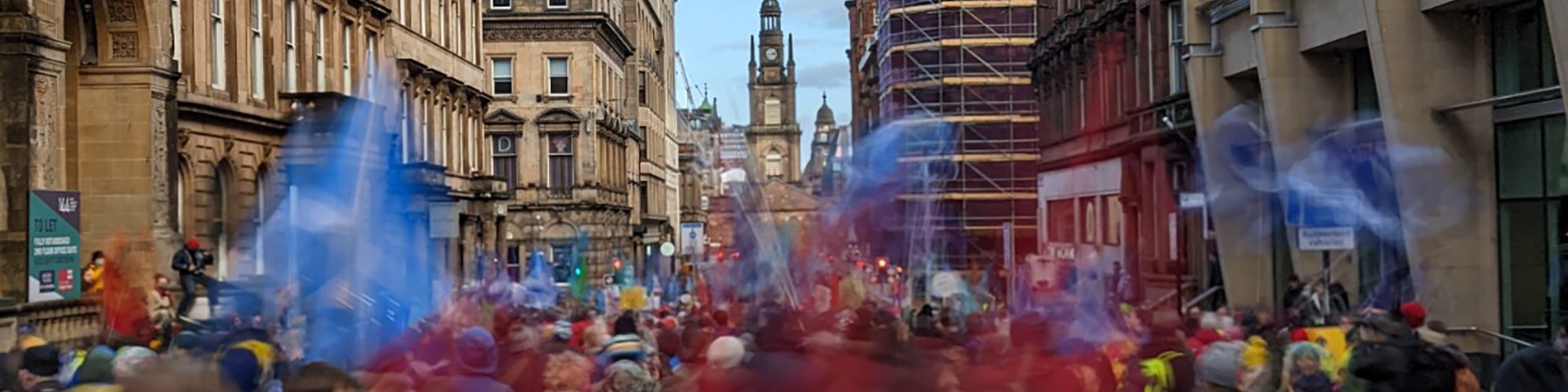
So what have been my first impressions? The scale of this conference is enormous. Not just in terms of how long it takes to walk through the event campus but also in terms of the subjects covered and the amount of people who are attending. It’s like rush hour in Central Station all the time. There are so many people with really interesting contributions. Everywhere you turn people are blogging, filming, making announcements and pledges. Earlier today I happened to be standing in Zone E, just beyond the television cameras from the international news feeds, and there was what looked like a walking scrum of people, lights and cameras that passed in front of me. Nancy Pelosi, the Speaker of the US House of Representatives was on her way to an event and was surrounded by the media every step of the way. This sort of thing doesn’t usually happen at any of the other sustainability conferences I’ve attended.
There is a buzz, a willingness to make things happen and to come together to make a difference. How to get more people involved is a common topic. It’s also interesting to hear government and business leaders admitting that they are much better informed that they were even three years ago and that many have identified what actions they can take to make an immediate impact.
But another theme that is also clear is that we’re not even close to meeting the climate pledges that have already been made, let alone set even more ambitions targets. Progress is too slow. Those nations who can afford to spend more on climate mitigation are reluctant to commit more funds and smaller nations are focussing on surviving the impact of climate change already. Just and equitable transition to low impact living are common themes of many presentations.
Many delegates also seem to have a lack of urgency and focus. In the Blue Zone there’s an area set aside for exhibition pavilions from many countries, organisations and interest groups. There are dozens of presentations happening at any one time and its common to hear applause or cheering breaking out across the arena. But there are also many people using laptops, on phones, answering emails and catching up on messages while sitting in these presentations. They aren’t giving them their full attention, they aren’t invested and make no contribution. It’s hard not to see this as part of the reason that we’re not making progress on our climate commitments.
There are moments that give cause for hope. In the exhibition zone there are some pavilions that are full of people and excitement. The indigenous peoples pavilion and the Nigerian pavilion sit side by side, are full of life and colour and a joy to be around. I loved the bamboo bicycle and the Pavegen technology that can generate electricity from walking over it – now there’s something to install in Central Station. I loved the presentation from Just Diggit (www.justdiggit.org), a Dutch Organisation working in Africa, and their way of linking story telling and technology to increase public involvement in their sustainability initiatives.
Bamboo bicycle
The buzz of COP26
‘People Live Here’ by Oliver Jeffers
Everyone was exited anticipating Barak Obama’s speech. His session was ticket only and few delegates had the opportunity to be there in person. It was available on the COP 26 Platform and via You Tube, with most people watching or listening to the livestream. I ended up sharing my phone with six others so we could all hear him at the same time. His talk was both inspiring and a reminder that pledges are easy to make but hard to put into practice. What I took from it was his encouragement for people to take their own action to help change their local communities, not to wait for governments to do something. It’s the same conversation that we’ve been having in Austin-Smith: Lord. Everyone has the power to make positive decisions that can help the environment and we can do that every day.
I’m looking forward to the next two days of COP 26 and what opportunities that might bring. Sharing knowledge and collaboration are key to making progress and I’d like to think that Austin-Smith:Lord and SEDA can help on both of those subjects.
What is your role within our Creative Collective?
Architect, WELL AP and Mental Health First Aider. I like to think of myself as an unofficial wellbeing champion in both design and practice.
What are you working on at the moment?
Woodchester Convent; Refurb of a Grade 2 listed convent into a luxury hotel and wellness centre (dream project!)
What inspires you most in your work?
Change. I enjoy materials that evolve over time, and spaces that can adapt. I think that’s why I love working with existing buildings so much.
What aspects of your work are you most proud of?
I believe I design with empathy; I’m not often very outspoken, but think I advocate for building users in what I design.
Which designers / projects do you most admire and why?
I’m sure I’m expected to pick an architect for this question but I’m going to side step into fashion and say Iris Van Herpen. Her work is so structural and sculptural but with a kinetic and fluid quality, it’s all beautiful.
What is your favourite Austin-Smith:Lord project and why?
Probably the Carmelite Monastery. Odd, because I’m an atheist, but I do admire the ability to harness spirituality and faith in architecture. Plus, who doesn’t love bricks?
What fictional place would you like to visit?
Neverland (the ‘Hook’ version)
What’s the best advice you’ve ever heard?
“Holding onto anger is like swallowing poison and expecting someone else to get sick.”
Complete the following – “I couldn’t get through the week without…”
Cheese, mostly.
Many of us have been receiving an exceptionally high amount of digital content regarding the climate crisis the world is facing, thanks to the COP26 conference that took place in Glasgow. Every major news outlet was covering daily news from the Blue Zone of the SEC Campus, intended to provide thorough coverage of political news and world leaders. Royal Institute of British Architects (RIBA) also hosted a Built Environment Summit in partnership with Architects Declare a week before COP26. The Summit highlighted the high percentage (38%) of global energy-related greenhouse gas emissions associated with the built environment, whilst Architects Declare emphasised the twin crises of climate breakdown and biodiversity loss and its consequence if we don’t act immediately. We are now much better equipped with vital facts and figures. The burning question is – what can we do, both as individuals living on this planet, and as a collective will within the built environment – before it is too late?
The first word that came to my mind about climate crisis is decarbonisation. It is commonly used to describe the process of removing and reducing carbon dioxide output from our economic activities. During the RIBA Built Environment Summit, I was particularly interested in the panel discussion entitled “Who Is Responsible for Decarbonisation: Industry or the Government?” The straightforward answer is BOTH; everyone working in the construction industry is in this together trying to solve the crisis. I was also surprised to hear that only a handful of architects within RIBA are taking on the lobbying role on behalf of the profession across the UK. This is negligible in comparison to other industries such as the green and renewable energy sector. Shouldn’t we be communicating and influencing policymakers on decisions to be made for the built environment?
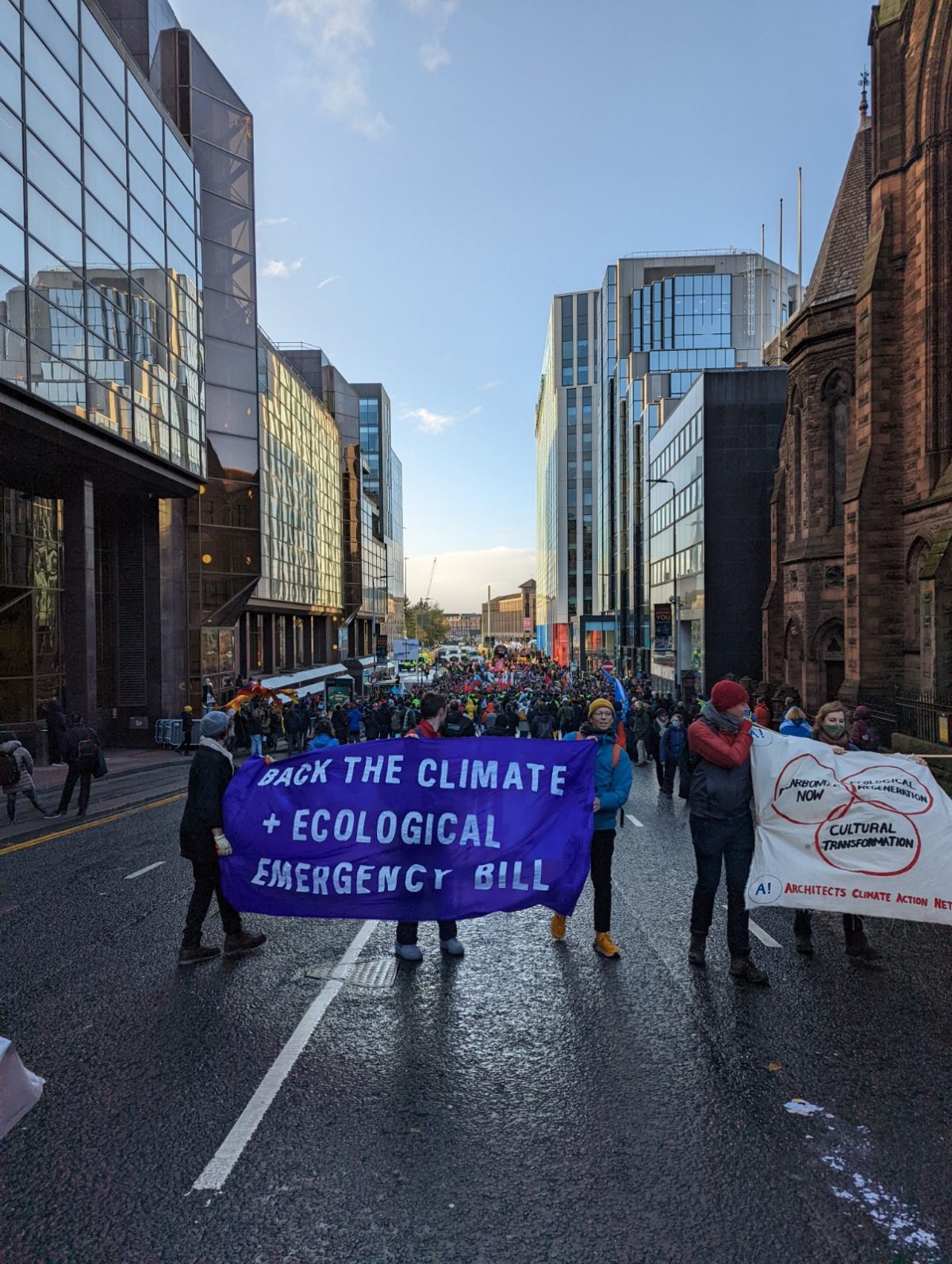
‘Global Day of Action for Climate Justice’ march during COP26
In terms of grass-root activism about the climate crisis, I have experienced COP26 first-hand in my home city. It is inevitable that most communities and media are not optimistic about the outcome of COP26. Greta Thunberg already called out the event as a ‘failure’ to tackle the climate crisis as an emergency, which then led to the trending of hashtag #blahblahblah on social media.
While the key discussions were taking place inside the highly secured SEC Campus, the public took to the streets expressing concern on the lack of actions from government. I also took part in the ‘Global Day of Action for Climate Justice’ march organised by the COP26 Coalition group, marching under the banner of Architects Climate Action Network (UK level) and New Glasgow Society (City level) with fellow architects from all over the UK. We met, we shared, and we got inspired by what everyone is doing regionally. These initiatives have been going on for years, and many have been campaigning relentlessly about built environment topics such as building retrofit, circular economy and the use of natural materials in the construction industry.
Architects are slowly breaking away from their silos across the industry, but it took a big event like COP26 to strengthen ongoing conversations between all groups. The overall consensus that I gathered is the lack of top-down incentives from the government, leaving the responsibilities to grass-root initiatives within the industry to move things forward.
Many architectural practices, including Austin-Smith:Lord, possess the creativity, technology and knowledge required to decarbonise the construction industry. But as a service provider, the design professions are limited without all stakeholders sharing sufficient amount of ambition, commitment and investment on policies. In my opinion, the next step for the design profession is to keep the momentum going after COP26 on the discourse with all parties developing practical and impactful ideas. The discourse will include stakeholders of all levels; government, local councils, clients and communities, so that we can secure the necessary commitment for change in decarbonising the built environment and wider economy.
(Y)our Future City Centre :
after COP26, Glasgow starts here
By Graham Ross (Austin-Smith:Lord), with Jeroen Zuidgeest (Studio for New Realities)
Graham and Jeroen have been working closely together, and in collaboration with many others, to consider a future strategy for Districts in Glasgow City Centre. The next four draft District Regeneration Frameworks for Glasgow City Centre will soon be published for public consultation. It is intended that these Frameworks become user-friendly and practical ‘Handbooks’ for change in the city.
Bringing together local and international perspectives here the team consider the future of Glasgow city centre in the context of COP26 and the call for action.
Glasgow and COP
COP26 is well underway here in Glasgow. World leaders have come, spoken and departed the scene, leaving delegates, scientists and diplomats to broker targets and pledges in an attempt to secure the political will, commitment to action and investment necessary to “keep 1.5C alive”.
As delegates and activists arrived in Glasgow for COP26 the sense of anticipation and apprehension was palpable as proceedings got underway. Would this be a good COP or a bad COP? Would proceedings get beyond “blah, blah, blah” and translate in to meaningful climate action? Time will tell; though when it comes to the climate emergency time is evidently not on our side.
Whatever pledges are made, whatever global targets are set, COP26 should prove to be a pivotal moment for the city of Glasgow. In hosting the UN Climate Change Conference Glaswegians will now be very aware of the climate emergency agenda. However, in common with folk across the world, what climate change mitigation and adaptation and what a fair transition to net zero means for them and their family, their everyday quality of life, their communities and neighbourhoods, their town or city, is less clear.
A New Approach to Place-Planning
Co-designing what that future looks like, and delivering the necessary change urgently and equitably, presents a huge challenge and a big opportunity for local communities, working alongside planners, specialists, entrepreneurs, investors and others to reimagine their place; not least here in Glasgow. Spatial design provides the ability to translate goals and promises into physical interventions; Design = Action.
Co-Designing (Y)our City Centre : participatory planning involved on-street and online engagement with local people (image : WAVEParticle)
Improving the way in which we plan places is fundamental to achieving fairer, healthier and more sustainable cities (towns and neighbourhoods). This goes beyond physical interventions to encompass the social, economic, health and environmental dimensions, and the new processes required to get the right things done. If we are to achieve a fair transition, minimise waste (resources, energy, time, creativity), restore biodiversity and habitats towards climate neutral places we need a holistic, collaborative and integrated approach that aligns with Scotland’s Place Principle.
Sustainable Glasgow
Glasgow has already navigated a transition from an industrial to a post-industrial city with a diverse creative, knowledge and service economy. But how can it now achieve a fair transition to a circular economy within a decarbonised city region?
This policy and strategic framework has started to reposition Glasgow to respond to the global issues of our era, including the climate and biodiversity emergencies. However, translating policy in to action at a local level (as well as at the city scale) will require leadership, a clear sense of purpose and the means of providing user friendly guidance, capacity building, engagement and funding to support and empower local communities.
District Regeneration Frameworks : Case Study
Glasgow’s City Centre Strategy (2014) identified 9 Districts; each one requiring a Regeneration Framework to establish a future vision and outline what should go where, and why. The 9 Districts cover the full extent of the centre of Scotland’s largest, and only metropolitan, city. Evidently the environmental, social, economic, cultural and civic health and performance of these Districts, now and in the future, is therefore of national as well as local and city regional significance.
Crucially the 9 Districts also consider the City Centre’s relationship to neighbourhoods along, and beyond, the River Clyde, M8 motorway and High Street providing an opportunity to extend the benefit of City Centre regeneration beyond central Glasgow and to better connect citizens to their City Centre so it is truly a place for all Glaswegians.
Glasgow City Council appointed multi-disciplinary teams to develop District Regeneration Frameworks (DRFs) for the City Centre’s 9 Districts in 3 phases, with a pilot first DRF for Sauchiehall and Garnethill undertaken by a team led by Gehl.
It’s (Y)our City Centre : a collective effort
Austin-Smith:Lord have had the privilege of leading multi-disciplinary teams for the subsequent second and third phases of the DRFs, covering 8 of the 9 City Centre Districts. We deliberately combined local and international expertise into a gloriously diverse multi-disciplinary team committed to working with local communities, local and national agencies, experts and stakeholders from all sectors of society and the economy to reimagine Glasgow City Centre.
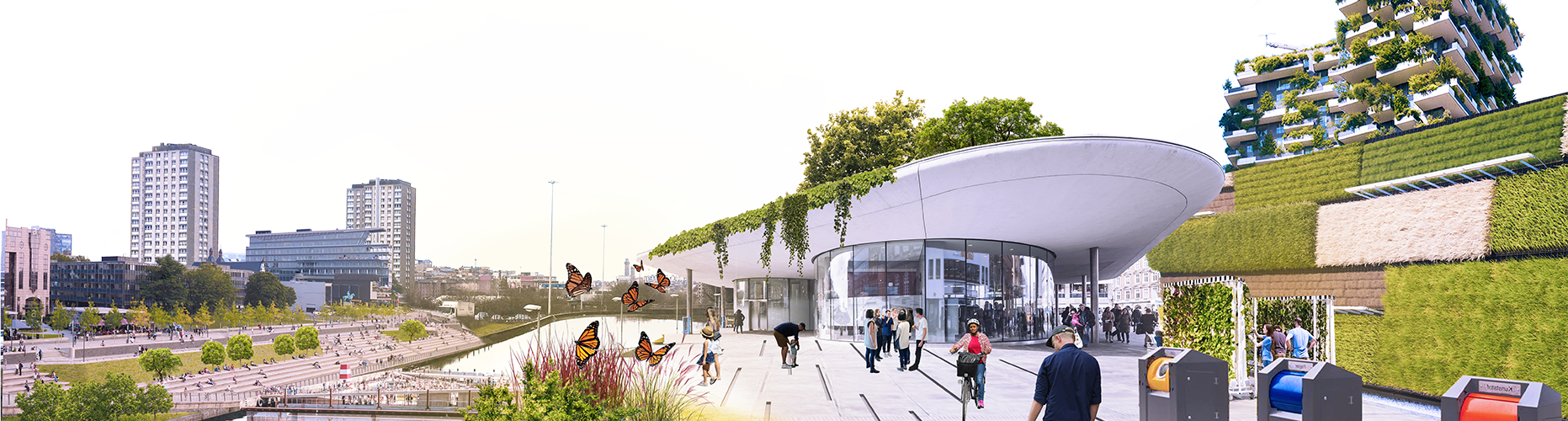
Smart Tartan Grid – transforming Glasgow’s streetscape with enhanced biodiversity (image : MVRDV with Austin-Smith:Lord)
The most important experts guiding the process have been the Glaswegian community – those that live, work, study, visit and invest in Glasgow City Centre. It is not Our City Centre it is (Y)our City Centre! Glaswegians have identified the priorities and urgencies in each District; from the micro to the macro, from tactical ‘quick wins’ to long term strategic transformation.
City Urbanist, Prof. Brian Evans, called on the DRFs, alongside other planning interventions, to simultaneously consider the role of the City Centre as contributing to Glasgow – the International City, the Metropolitan City and, most especially, the Everyday City – reinforcing that need to enhance quality of life for all, everyday.
Using a pioneering, innovative and interactive process of sustainable urban planning the DRF approach is;
Community-led with co-design and participatory planning
Evidence-based urban data analysis, fieldwork and observation
Human-centred urbanism to develop future vision, plans and projects (micro to macro) to enhance quality of life for all
Action-driven approach to enable partnership working, delivery, monitoring and evaluation against KPI metrics
The second phase, led by Austin-Smith:Lord with MVRDV and Space Syntax and a multi-disciplinary team, prepared DRFs (now adopted) for Broomielaw, St. Enoch, Central and Blythswood. This work, undertaken in 2016 and 2017 and co-designed with more than 5,000 contributions from Glaswegians, sought to lock in best practice in sustainable urbanism. This involved extensive on-street and online engagement, including community animation work undertaken by WAVEparticle.
These DRFs provided evidence to the Connectivity Commission, championed the repopulation of the City Centre (with associated community infrastructure) and the adoption of a compact mixed-use city concept. The DRFs called for the restoration of built heritage and incentivised retrofitting of existing buildings, the need to alleviate severance caused by the M8 motorway, reallocate the over provision of road space to create streets and spaces for pedestrians, active travel and civic life and advocated an extensive programme of ‘greening the grey’ – notably along the Clyde to create a continuous River Park.
It has been heartening to see subsequent progress (in part super-charged by the Covid response) to boost City Centre living, advocate for 20 min neighbourhoods, reallocate road space through the Avenues and Spaces for People programmes, progress public transport investment and promote the River Park concept and nature-based solutions alongside early community action to improve key locations and connections such as at Anderston Cross.
Handbooks for Change : enhancing quality of life for all
The third and final phase led by Austin-Smith:Lord and Studio for New Realties, in collaboration with Urban Movement and WAVEparticle and a wider multi-disciplinary team, was appointed in March 2020, immediately prior to the Covid pandemic, to prepare DRFs for Cowcaddens, Townhead, the Learning Quarter and the Merchant City.
NE Districts cover a diverse area of the city centre, including the medieval core, between the Clyde and the canal (image : Google Maps base)
These DRFs will be public documents, to be adopted by the Council and used as ‘Handbooks for Change’ by communities, the Council and partners to deliver local regeneration with maximum focus on the everyday quality of life of Glaswegians in the City Centre. Each DRF ‘Handbook’ seeks to address the climate and biodiversity emergency, tackle Glasgow’s health, social and economic inequalities at a local level, develop an appropriate post-Covid response, and boost quality of life for all with a hands-on approach. The DRFs are local in focus but with a national significance and potential to influence best practice elsewhere in Scotland and further afield.
Regeneration for Who?
The DRF Handbooks aim to provide practical place-based guidance that can help inspire and drive community-led action, partnership working and secure funding and investment to guide regeneration of the 4 Districts in the north-eastern half of central Glasgow. A NE Districts Strategy that outlines overarching goals, principles and strategic projects will accompany these DRF Handbooks and seeks to coordinate action across all 4 Districts.
Progressed throughout the pandemic these DRFs have utilised a range of online participatory planning techniques devised to engage with hard to reach and under-represented groups in each District. This has resulted in over 4,000 contributions via over 200 meetings, 54 workshops, 44 online community events and webinars, 20 no. 1 to 1 interviews, 3 Freephone line sessions (to minimise digital exclusion) and 2 dedicated project websites capturing issues, ideas and solutions from Glaswegians.
(Y)our Place Map captures local perspectives from under represented voices in the Districts (image : WAVEParticle)
Glasgow Started Here. Future Glasgow Starts Here!
The DRFs for Cowcaddens, Townhead, Learning Quarter and Merchant City cover a fascinating part of Glasgow that has suffered neglect and a sense of disconnection but presents an opportunity for the city to rediscover and reposition itself. Many communities in these Districts don’t self-identity as being in the City Centre and some areas exhibit stark contrasts in quality of life. However these Districts also have immense potential, talent, energy and appetite for change.
In combination these 4 DRFs encapsulate 280 hectares of central Glasgow and are home to over 20,000 people, over 2000 businesses employing over 55,000 people as well as hosting and knowledge cluster comprising 5 leading HE/FE institutions (University of Strathclyde, Glasgow Caledonian University, City of Glasgow College, Glasgow School of Art and the Royal Conservatoire Scotland) with over 65,000 students and Scotland’s first climate neutral Innovation District. This half of Glasgow City Centre is also home to world-renowned cultural and creative institutions, venues and practitioners. This combination of assets and talent is remarkable and the potential synergies very exciting.
Significantly this is, of course, where Glasgow started – with the Cathedral and the High Street linking to the Clyde and Glasgow Green – the foundation of our Dear Green Place. The history of the place is apparent in its intricate, layered and complex built and social heritage.
In contrast to the ‘core’ City Centre to the south-west, the north-east half of the City Centre presents an opportunity to fundamentally transform the City Centre, and by extension the communities towards the North and East. This ‘yin-yang’ interplay can help provide a powerful paradigm for Glasgow whereby the north-east can develop a positive and distinctive identity that fuses and reconciles the history of the place with a progressive, dynamic, healthy and thriving contemporary urbanism, to strongly contribute to the functioning, performance and quality of the City Center as a whole.
Glasgow started here. Glasgow’s next chapter should also start here!
The NE Districts in Glasgow City Centre can complement and help redefine the rest of the city centre (image : Studio for New Realties with Austin-Smith:Lord)
Delivering the DRFs
The DRF Handbooks are intended to be user friendly and action-driven. They should enable citizens, communities, city leaders and stakeholders to define priorities for action – from ‘quick wins’ and hyper local projects to major strategic infrastructure of national significance requiring multi-agency partnerships over the next generation. The DRF Action Plans identify potential partners, funders and investors from public, private and third sectors. Community empowerment and capacity building, community asset transfer and social enterprise are an integral part of delivering the circular economy and community-led ambitions of the DRFs.
The North-East DRF ‘Handbooks’;
Define an ambitious and appealing vision for the NE City Centre and each District to guide future development
Enable a mind-set shift in the way to plan, procure and deliver regeneration and development
Embed ambitious and practical sustainable urbanism in an holistic way
Develop a strategic framework at City Centre and District scale; focussed on creating a well-connected city, with great streets and spaces, thriving Districts and identifying drivers and enablers for change
Implement an action-driven, projects-focussed development strategy with ‘quick wins’ and priority projects evaluated against outcomes
‘Get the basics right’ as a precondition to successful regeneration
Key Moves and Drivers for Change
The DRF Handbooks outline a range of projects across all four Districts to contribute to the following key moves and themes;
Working with What We Have : by recognising the available space for change and alignment of existing policies, identifying positive uses for vacant and derelict land, prioritising retrofit and repurposing of under-occupied buildings and optimising performance of existing infrastructure.
Distinctively Glaswegian Approach : seeking to fuse the city’s creativity and ingenuity with its gallus ‘can do’ spirit to restore and reinterpret the city’s incredible heritage, encourage innovation and support community-led local action.
Repopulating the City Centre : improving quality of life for existing communities, whilst accommodating 20,000 new residents in the next 15 years to create compact, mixed 20-minute neighbourhoods in the City Centre with convenient access to community facilities, amenities, services, jobs and city life.
Creating a Dear Green Place : with clean green-blue infrastructure and nature networks connecting between the Clyde, the Canal and the Kelvin by improving existing parks and open spaces, transforming vacant and derelict land, enhancing biodiversity, access to water, nature and places to play, relax, cultivate and enjoy.
Well-Connected City : with slow and low traffic neighbourhoods – let’s call them (S)low Traffic Neighbourhoods! – safe child-friendly streets, continuous active travel networks for walking, wheeling and cycling and an integrated bus-subway-metro-train transport system to create an inclusive, accessible and liveable City Centre for all.
Great Streets and Spaces : extending the Avenues and restoring historic arterial ‘Great Streets’ across the City Centre and connecting surrounding communities by dissolving the severance caused by the M8 and High Street to create qualitative streets and public spaces that bring the city together. Starting with a focus on rejuvenating the High Street and reducing the impact of the motorway on the City Centre.
Thriving and Productive City Centre : with a diverse day and night economy that supports existing businesses, new enterprise and ways of working, championing the globally renowned creative economy, the climate neutral Innovation District and transforming underutilised areas to an urban production zone to sustain a productive and increasingly circular economy.
Reinforce Alliances : between the major and leading educational, cultural and healthcare institutions clustered in NE City Centre to collaborate as a unique global alliance, share ideas and resources and be enablers for change and drawing upon knowledge and expertise to have real and practical impact in partnerships with local communities.
Climate Neutral : extending the ambitions of the climate neutral Glasgow City Innovation District to develop City Centre-wide energy, smart infrastructure and digital networks to decarbonise the City Centre, draw-upon renewable energy sources (eg. water-sourced heat pumps in the Clyde).
Ideas to Action
The 4 DRF Handbooks have been developed in collaboration with local people and various stakeholders. They will be published online in early 2022 for final public consultation. Together with an overarching NE City Centre Strategy Document, the DRF Handbooks bring together 100+ projects; from XS, S, M, L to XL.
The DRF Handbooks seek to guide what should so where, and why, and how to deliver change (image : Studio for New Realties with Austin-Smith:Lord)
Measuring and Monitoring Outcomes
Key measures of success and benchmarks to assess the city’s performance and to monitor project implementation and impacts were developed into a DRF Scorecard. These draw together international (incl. UN Sustainable development Goals), national and local policy alongside themes inspired by Doughnut Economics and metrics developed by the team’s lead sustainability advisers, Useful Projects to cover the following topics;
A Thriving Economy
A Vibrant City
A Healthier City
Better Connected Places
Climate Neutral
Resource Efficiency
Restoring Nature
More Resilient Communities
Each of these outcomes is defined against indicative qualitative and quantitative measures and the DRF proposes KPIs that should be honed to create a City Centre Performance Monitor that can help develop and deliver agile policies to implement change and assess impact.
Postcard from the Future; imagining a City Centre with a nature network of green-blue open spaces for communities to enjoy (image : Studio for New Realties)
Considered collectively the DRF Handbooks may present a daunting prospect. Delivery requires partnership, commitment and focus. The Outcomes listed above provide a framework against which to identify priority projects and actions to have most impact. To assist next steps, each DRF Handbook identifies quick wins and suggests coalitions to progress urgent projects in a practical way that intends to be user friendly, impactful for citizens and communities whilst addressing the climate emergency by thinking globally and acting locally.
In the meantime, if you’ve a great idea to help make (Y)our City Centre better, don’t hold back. Get in touch via the email below and discuss how to progress (Y)our Ideas.
Let’s start tomorrow!
Each Handbook set out a Future Vision for each of the NE Districts (image: Studio for New Realities with Austin-Smith:Lord)
About the Authors
Graham Ross is a Glasgow-based architect, urban designer and planner and CEO of Austin-Smith:Lord who has led the multi-disciplinary team preparing 8 of the 9 DRFs for Glasgow City Centre (Phases 2 and 3), providing local Design leadership and facilitating conversations with Glaswegians, local and national stakeholders to inform the final DRF Handbooks. Graham presented the progress of the DRFs to date at the RIAS Convention “Draw Together” held in September 2021. You can watch his presentation here.
Jeroen Zuidgeest is founder of Studio for New Realities, strategic planner and architect, responsible for the Urban Strategy / Design Lead for the Phase 3 DRFs (6-9) for Cowcaddens, Townhead, Learning Quarter and Merchant City, and co-responsible for the Phase 2 DRFs (2-5) for Broomielaw, St. Enoch, Central and Blythswood in his previous position as Partner at MVRDV.
Blog by Emily Harper, Architect, Austin-Smith:Lord
As restrictions ease and people head #BackToMuseums, what can they expect? How are museums, and more broadly, the cultural sector, evolving? Over the past year the Museums Association has produced a webinar series called Coronavirus Conversations and these have been a fascinating insight into the events of the pandemic, their impact on the sector and how museums have reacted. Most discussion however has focussed on how the sector moves forward.
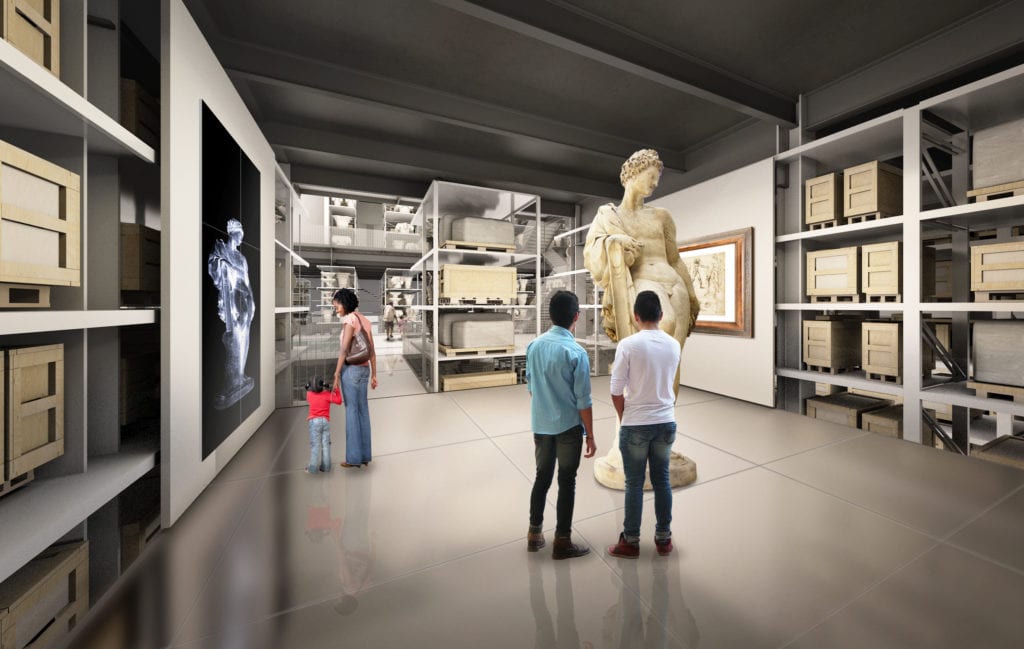
The covid-19 pandemic saw a vast increase in the number of grants awarded to museums to bring forward or speed up the digitisation of their content and collections. This is obviously an advantage for accessibility and outreach, but where does the pandemic leave the physical spaces museums inhabit? This is of particular interest to us given our experience of working on Museum projects and in particular due to our current involvement in the V&A Collections and Research Centre; a bold new building typology for accessing collections independent of the pandemic which is pushing the sector to rethink the exhibition model.
Digitisation is vital for archiving collections; our experience on the CRC shows just how much museums have in storage that the public have never seen, and it opens up collections to so many more people globally. There is also a place for digital material within museum exhibitions themselves; the design for the CRC incorporates interactive digital explorations of the collection within the store, and integration of digital interpretation into design will be ever more prevalent. However, digital isn’t the whole answer to accessibility and it’s no substitute for experiencing the real thing. Museums are fully aware that after months of working from home, Zoom meetings and the increasing occupation of social media by our parents, many people are disenfranchised with the digital world. More seriously, digital poverty affects approximately 10% of the UK.
So how do we work with museums to design the real thing and provide new, safe spaces?; indoor social distancing, if not legislated then a cautious choice, and ticketed entry will inevitably limit visitor numbers for some time; a reduction in international tourism will increase reliance on local interest and, given the current pressures, a cultural day out isn’t a priority for many people.
Accordingly, and with acute awareness of their impact on wellbeing, museums should be – and many are – looking to take the museum to the people in everyday environments and promote analogue content. Ideas include occupying empty retail units – a side effect of an evolving high street as well as the pandemic; pop-up exhibitions, and using public parks, as well as collaborations with other public services such as hospitals. There is precedent to these methods, but it feels necessary to be seeing them as longer term models for display and engagement; creating more accessible experiences both through physical location and public perception.
Helensburgh Town Centre
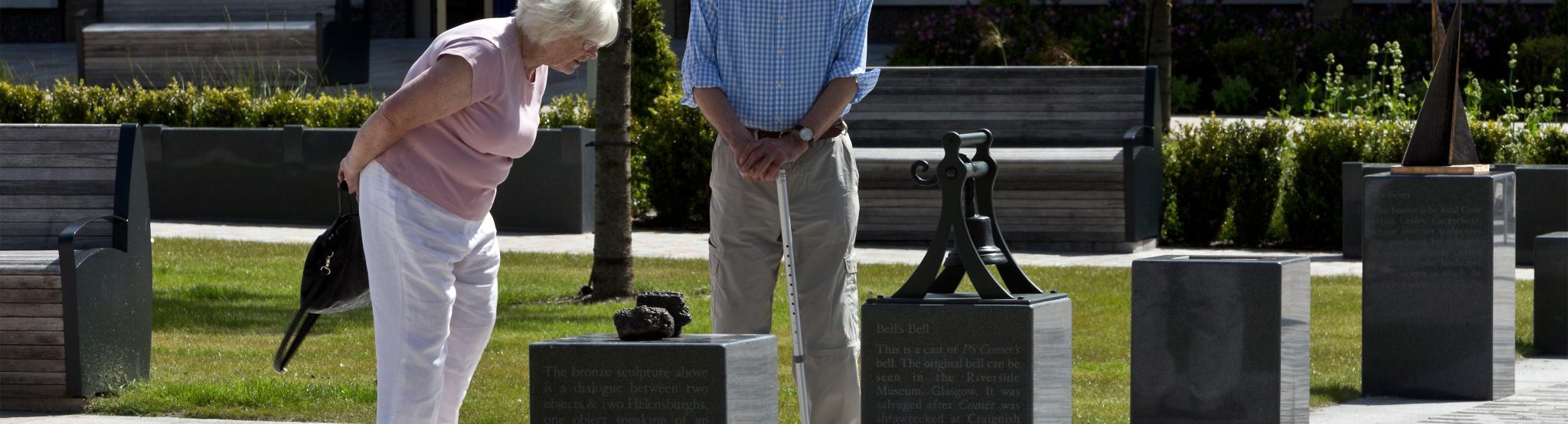
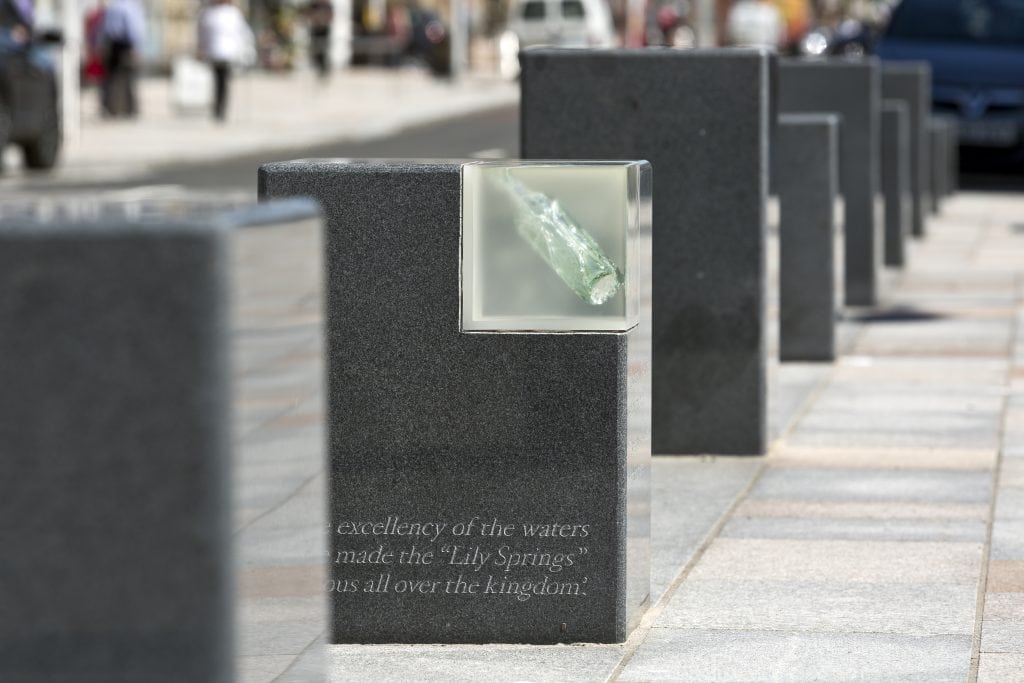
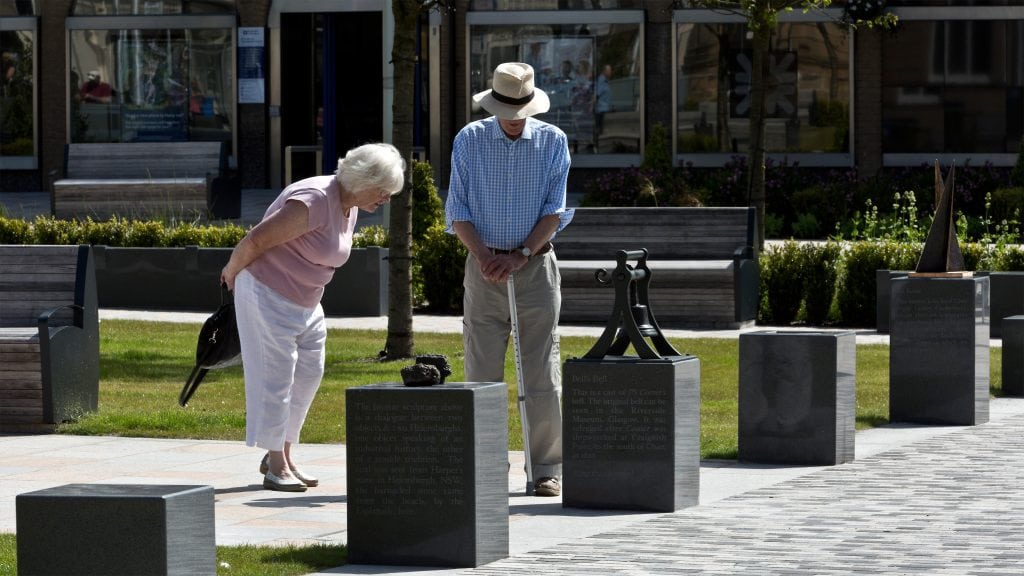
In 2017, Hull successfully filled a number of empty storefronts with exhibitions in their bid to become UK City of Culture; In 2019, Manchester Museum displayed the skeleton of Maharajah the Elephant on the concourse of Manchester Piccadilly station while the museum underwent refurbishment works; Austin- Smith: Lord has previous experience with outdoor museums having been involved with the design of Colquhoun Square in Helensburgh, the only exhibition model that will have maintained, or maybe increased, visitor numbers over lockdown; and more recently we have been appointed to convert an ex British Home Stores in Swansea into the City’s new archive and library – a trend set to be utilised by many sectors to transform the way we experience our town centres.
There will of course remain multiple considerations in implementing new museum and cultural environments; health, security, insurance, environmental conditions, collection management and funding to name a few. And as designers and problem solvers, we will have to spatialise these aspects while addressing the overarching challenges in helping museums engage with the public across all timescales; occupying temporary space, adapting current space and creating new space. Creativity is a side-effect of crisis and now the cultural sector needs to capture the zeitgeist and hold on to a new vision of accessibility and inclusivity.
Outdoor Museum, Helensburgh. Image Credit Keith Hunter Photography
The heart of the community - The Reader at Calderstones Mansion
Blog by Mike Yates, Director, Austin-Smith:Lord
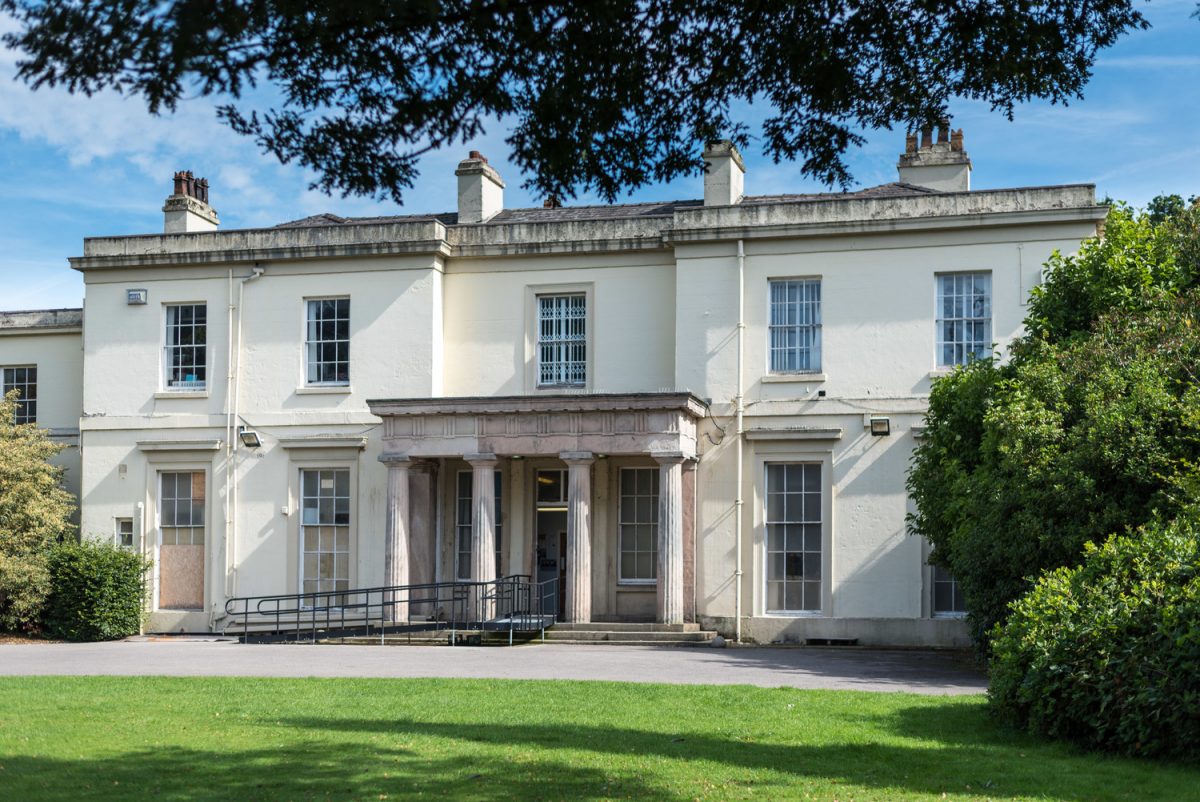
The new International Centre for Shared Reading was completed in Summer 2019 in the newly refurbished Calderstones Mansion, where The Reader have been building the foundations of a community hub since 2013.
Jane Davis, Founder and Director of The Reader, explains: “What makes people happy, above all, is a network of supportive fellow creatures, a sense of purpose, challenge and meaningful occupation.
“Shared Reading can provide all this, but we know that many of the people we reach need more than a couple of hours Shared Reading each week. Even for the most obsessive readers, life is not only books and reading: we need other creative and happiness-inducing activities.
“This is why we have created The Reader at Calderstones – a place open to all and full of possibilities, all held together by a golden thread of literature.”
The project’s story is one of rediscovering a Georgian Mansion House with its roots in the Cunard Line and Liverpool’s merchant past, creating a proper setting for and conserving the Neolithic Calder Stones and bringing back to life a post war outdoor Art Deco Theatre in a secret garden.
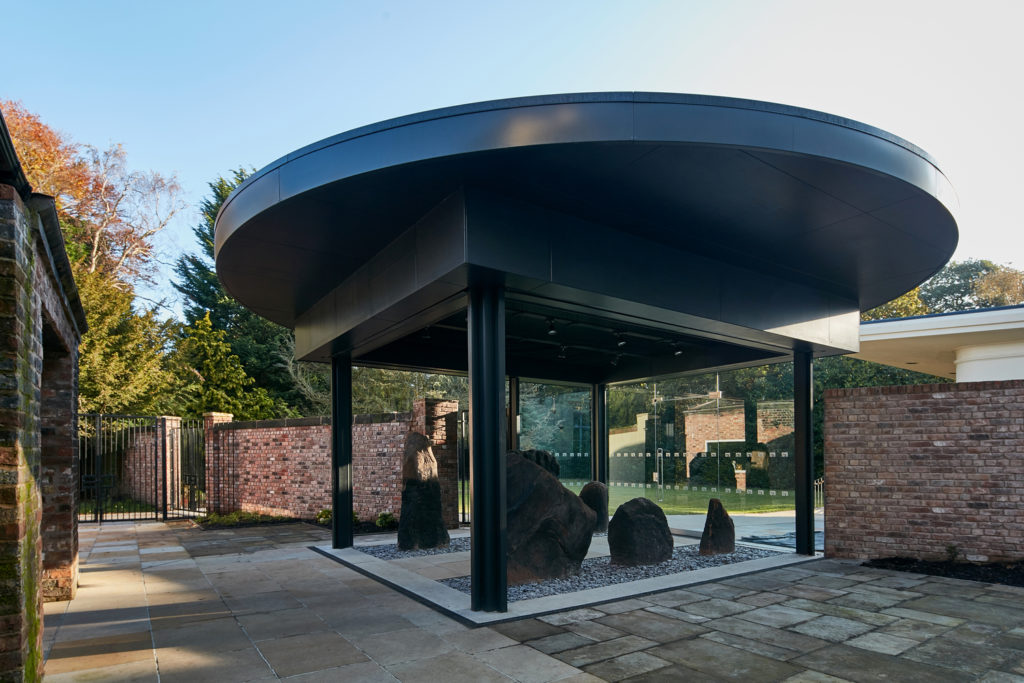
The Calder Stones from which the park takes its name are six pre-historic stones thought to be from a chambered burial mound on a nearby site. They were languishing in the old vestibule to the now demolished Harthill Greenhouses within the park. The stones were poorly displayed and difficult to access. Repositioning the Calder Stones to a more accessible location was a significant objective, reconnecting the park with its history.
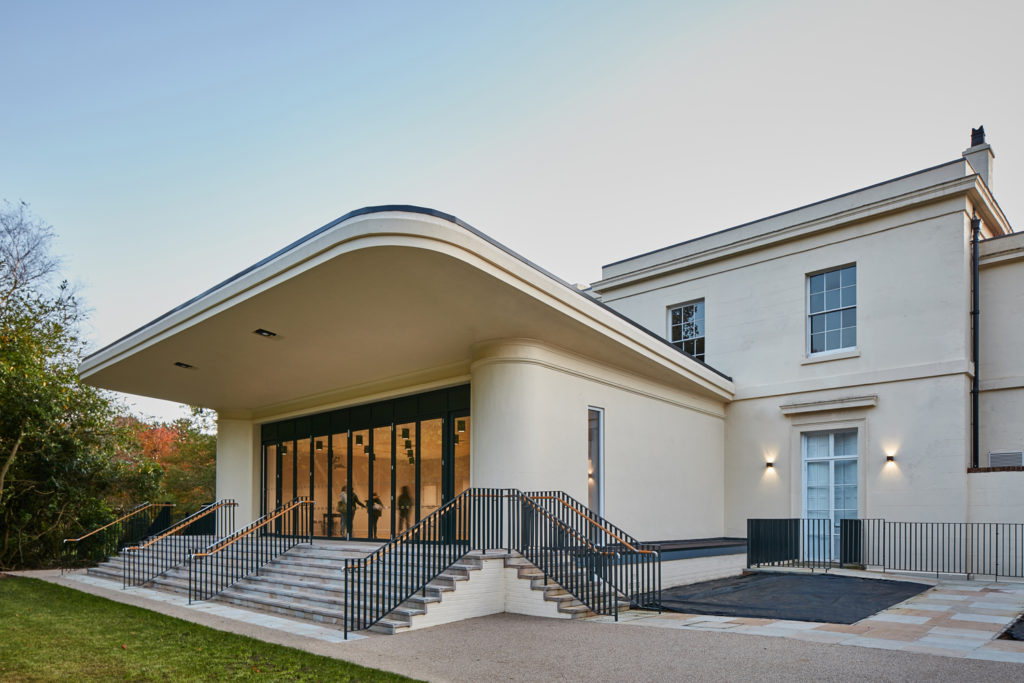
The capital works include reading rooms, library, a period room, a function suite including bar, café, offices, tenant spaces, workshops, shop, exhibition space, gallery and outdoor theatre, which was jointly funded by the NLHF and Liverpool City Council.
The project is the next phase of a masterplan which began with The Reader Ice Cream Parlour (2015) and The Storybarn (2016) in the stable block courtyard and future phases that include the conversion of the stable block into residential accommodation.
The Calderstones community, volunteers, group members, staff, visitors, customers and local residents are at the heart of what the Reader do, they are immensely proud of the community and consider themselves fully accountable to it.
During the design period The Reader held regular meetings with the Friends of Harthill and Calderstones Park and regularly sought feedback from the community through customer surveys, social media, notice boards and by staff being visible and approachable on site. This served to provide continual feedback during the design stages as the plans developed.
Substantial community consultation and engagement took place with 1,400 people attending Open Days and dozens more attending public meetings during which the plans were shared.
Comments were taken on board and incorporated into the brief and design development. Typical feedback was:
“What will be on at the Mansion House?” “Will there be a bar?” “What about the Park toilets?” “Will the building be fully accessible?” “Can I bring my dog into the Mansion House?” “What is happening with the Calder Stones and the glasshouse?”
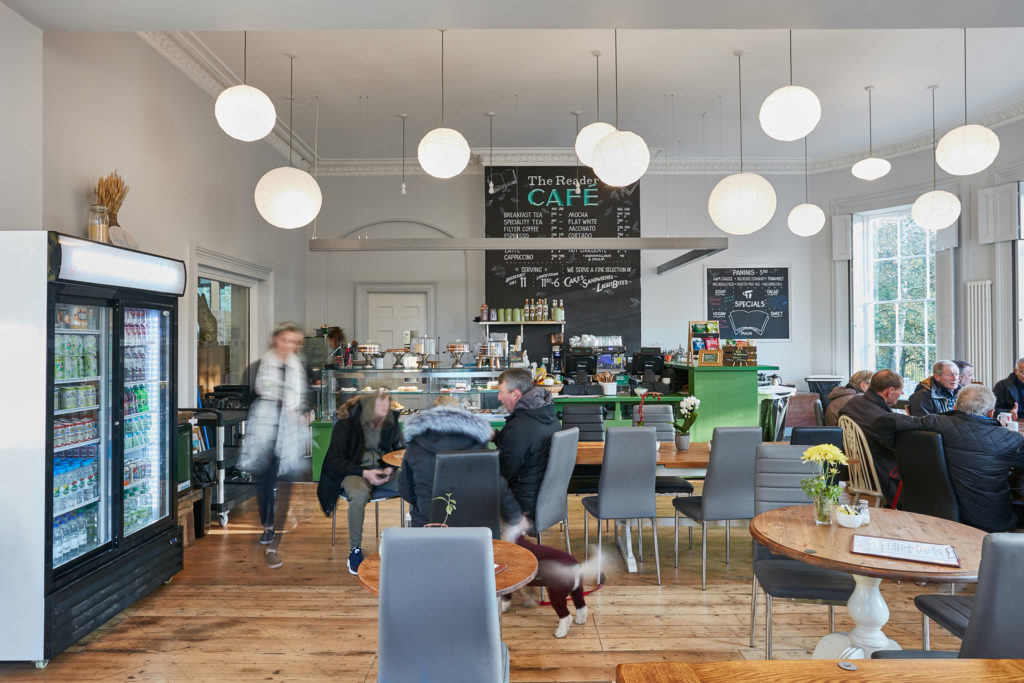
Consultation endorsed the vision and the facilities to be provided. It also informed the detailed briefing such as: a temporary café being provided in the stable courtyard during construction and the new café being dog friendly.
Typically feedback was positive such as the following comment on the proposals for the Calder Stones:
“Very nostalgic! I grew up passing the Calder stones which originally stood outside the park gates every day as I lived across the road. Glad they will have a lovely new home where they can be appreciated.”
The mansion house with its associated stables, coach house and walled garden at the heart of the former estate, now Calderstones Park, is an important historical relationship which had arguably become more tenuous over the years. The reconnection of the house and its outbuildings with the park was an important part of the design concept.
The project reunited the house and its outbuildings under one ownership enabling the community to access both the house and park much as family and friends of the mansion’s owner would have done in earlier times, giving visitors an insight into the history of the estate while providing a sustainable contemporary use for the mansion house.
The grand original house largely accommodates public and events spaces such as the café, function space and bar. The existing character of the original mansion house creates a “boutique hotel” feel for special events such as weddings and festivals with the restrained classical façade and portico providing an impressive setting and entrance. To the rear the mature “secret” garden” is the perfect outdoor auditorium for the theatre and backdrop for weddings and festivals.
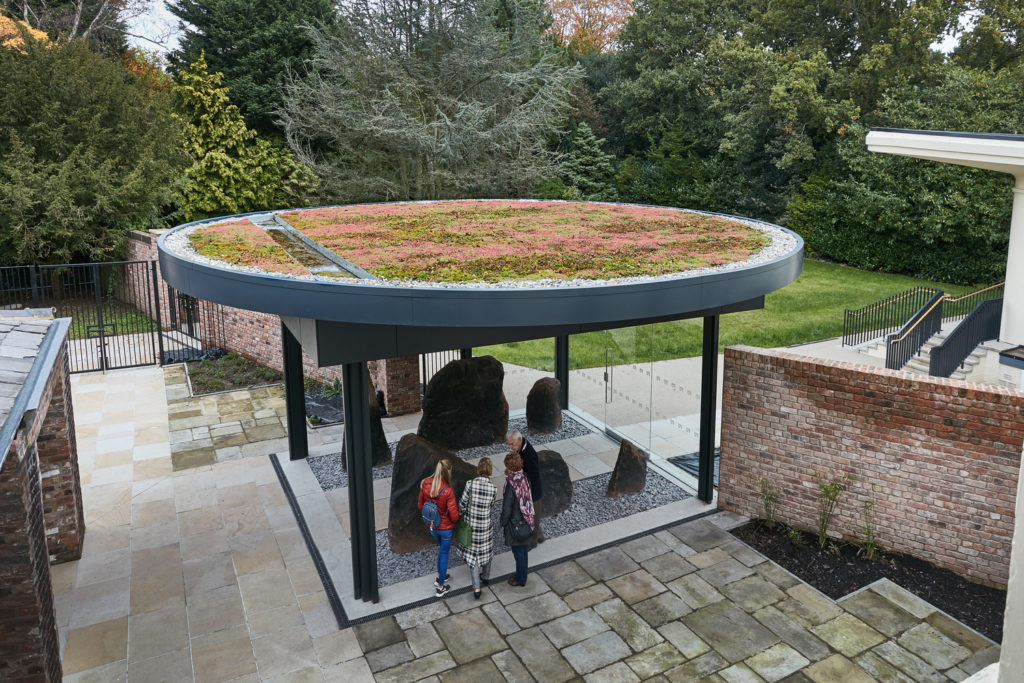
The Calder Stones are positioned in the courtyard between the “secret garden” and the interpretation space. They are arranged in two rows and covered by a domed green roof to recreate a sense of their association with the structure of a prehistoric chambered burial mound
The former service wing of the house primarily accommodates The Reader facilities including reading rooms, library, volunteers welfare facilities, tenant spaces and The Reader’s offices.
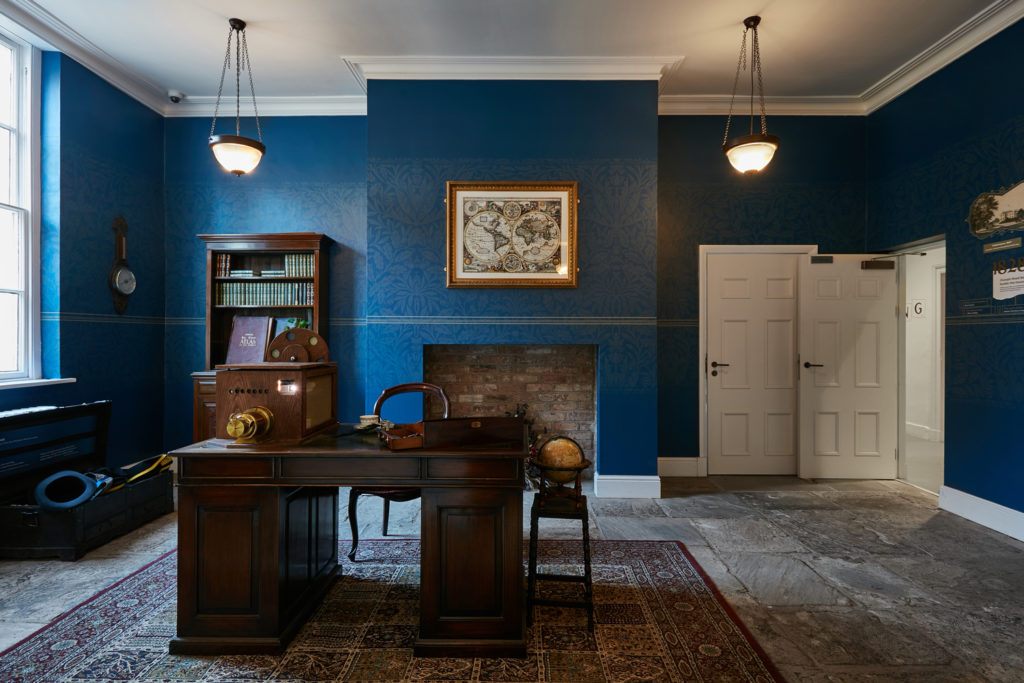
The interpretation room is also in this part of the house which recreates a Victorian sitting room furnished as it might have during the ownership of the McIver family. Next to the interpretation room is a gallery space for sale of artwork by local artists.
“Every building must have… its own soul.” Louis Kahn
The soul of a building can depart if it is not loved and cherished by its occupants and community. At Calderstones Mansion its soul had long since left when The Reader came to the rescue of the badly neglected building.
From the outset we developed an approach with the Reader to strip away the inappropriate layers to reveal the original character and history of the Mansion House and its Art Deco theatre and place the Calder Stones at the heart of the park. From this starting point we were able to reach back into the past to reignite the soul of the building with the spirit of its new owner and a sense of continuity.
Key to this approach has been the rediscovery and opening up of the grand entrance hall which had been destroyed as a space with inappropriate internal partitions and the careful insertion of new elements such as the café and bar in a contemporary style that establishes the personality of The Reader while articulating old from new.
The Reader have fully realised their vision by adding to the interior design with an eclectic mix of period furniture, chandeliers and signage artwork. The partnership between The Reader, the community and the architectural team has been a great success. The resulting rich architectural mix and vibrant community carry the torch of the new soul of the Mansion House.
The Covid 19 pandemic has caused The Reader to close its facilities in Calderstones Park, but the community continues to meet virtually while the kitchens have been providing an essential service for the local vulnerable community. The café has now re-opened beginning the road to reclaiming the vision. As with many other community services the future will undoubtedly incorporate innovations in the virtual world, but the joy and benefits of a physical community that underpins this project is its strength and can never be replaced.
Austin-Smith:Lord and the Victoria and Albert Museum –
25 years at the forefront of conservation and archive space design
Part 2 – 2018-2023: The Collections and Research Centre
Blog by Rob Firman, Director, Austin-Smith:Lord
In 2018, based on our experience of delivering similar projects throughout the UK, Diller, Scofidio + Renfro of New York invited us to act as their Local Representative for a project to prepare designs for a new Collections and Research Centre for the V&A and together we were successful in securing the commission.
Just like the RCA project 25 years before, this commission is focussed on the provision of state of the art facilities for the Museum, although in this case those facilities will accommodate its collection of artefacts and objects currently stored in an adapted and out-dated, inefficient Victorian building in Olympia.
Also mirroring the RCA project, the new V&A Collections and Research Centre will be located in an existing building, albeit a contemporary one – Here East at the Queen Elizabeth Olympic Park in East London. Constructed for the 2012 London Olympics and offering a vast internal volume within a 21st Century envelope, the building will be adapted to provide a purpose-built home for 250,000 objects and an additional 917 archives from the V&A’s collection of fashion, textiles, furniture, theatre and performance, metalwork, ceramics, glass, sculpture, architecture, paintings and product design.
From the outset the project has represented a paradigm shifting experiment, the first of its kind to give the public anything like this level of access to one of the nation’s priceless collections. A central public collection hall will turn the storage inside out and a rich array of objects will be on display for visitors to explore – from some of the smallest curiosities in the collection to the largest and most significant rooms and building fragments. Further spaces within the Centre will host pop-up displays, education workshops, performances and screenings alongside live encounters with the museum’s work – from conservation and research to exhibition preparation.
The introduction of visiting members of the public into the archive and collection storage spaces raised significant challenges for the design of environmental controls as well as bringing considerations for visitor and staff life safety and security to the forefront of design thinking.
The process of coordination of the architectural concept with mechanical and electrical services, sprinkler installations, security controls and a complex fire strategy and storage racking systems took many hours of our team’s time. In one further echo perhaps of the RCA precedent, all services installations within the Collections Hall volume, workshops and conservation studios will be exposed to view within the ‘industrial’ aesthetic adopted for the architectural concept.
Construction operations for the new facility commenced on site in the spring of 2020, 25 years after the completion of our first project for the V&A. It will be ready to receive the collections in the second half of 2021 and when they have all been moved into the new facility the CRC will open to visitors in 2023.
The CRC project has drawn from, and built upon, our existing extensive experience of designing Museum and Archive projects and we believe will set standards for this building typology for many years to come.
Read Part 1 of this blog (1992-1995: The Conservation Department) here


 Name
Name


 Name
Name